Author name: 胡思

Electric Hydrofoils: Redefining Urban Transport

The Economist has noted a seemingly novel yet potentially transformative technology for urban transportation: electric hydrofoils. On the surface, these vessels appear to ‘fly,’ but the true significance lies not in their visual appeal, but in the fact that they provide a long-missing transportation option between railways and ferries.

Hydrofoils are not a new invention. For Hong Kong residents, the Hong Kong-Macau high-speed ferries have long dominated cross-border travel. Before the opening of the Hong Kong-Zhuhai-Macao Bridge, water transport was almost the only high-frequency, predictable, and timely option available. With speeds exceeding forty knots and a travel time of nearly one hour, they facilitated significant human and economic exchanges between the two regions. Hydrofoils were not rendered obsolete by technology; rather, they were replaced by an extremely costly bridge.

However, the Hong Kong-Zhuhai-Macao Bridge is an extreme case. Building a bridge of this nature involves artificial islands, environmental assessments, long-term maintenance, and risk management, with costs often reaching hundreds of billions. Such investment levels are simply not replicable for most cities. In areas where giant bridges cannot be constructed, water transport often remains ‘logically sound yet unfeasible.’

The resurgence of electric hydrofoils stems from the simultaneous maturation of several technologies rather than a single breakthrough. First is battery technology, which, despite still having limited energy density, is sufficient to support stable cruising speeds of twenty-five to thirty knots, ideal for urban and suburban routes. Next are sensors and control systems, which allow modern hydrofoils to adjust wing angles in real-time, actively compensating for waves and significantly enhancing stability. Additionally, composite materials make the hull lighter and the structure simpler, thereby reducing maintenance costs. Electric propulsion also brings low noise and vibration, making high-frequency services more acceptable in urban environments.

Applying this logic to the geography of the UK clarifies its effects. Take Cardiff, the capital of Wales, and Weston-super-Mare in England as an example. The water route between the two is not far, but the land route must detour through the area around Portishead, resulting in delays whether by car or train. If electric hydrofoils were to operate direct services, the journey could be kept to just over thirty minutes, potentially compressing the door-to-door time to under forty-five minutes. The reason such routes have long been neglected is not due to a lack of demand, but because past vessels were too slow and bridges too expensive.

Similar situations exist between Portishead and other towns, as well as between Liverpool and Wirral, and various towns downstream of the Thames in London. Water routes have always existed but have never been considered a primary mode of transport. Railways cannot overcome geographical limitations, roads only exacerbate congestion, and bridges far exceed financial capacities. Electric hydrofoils do not need to replace any existing systems; they merely need to serve as tools to ‘straighten routes’ to change certain commuting patterns.

The true significance of electric hydrofoils lies not in a race for speed, but in reminding cities to reassess their geography. When a bridge is too expensive, a road too convoluted, and water surfaces readily available, the options may never have been lacking; rather, we simply have not used the right tools.

Electric Hydrofoils: Redefining Urban Transport Read More »

The Rise of Airbus and the Role of Britain

The dominance of the civil aviation market has undergone a structural shift. This is not merely the result of a cyclical economic trend over one or two years, but rather a gap that has accumulated due to long-term route choices. The disparity is evident when viewed through the most direct figures.

In terms of delivery volumes, Airbus has consistently outperformed Boeing for several years. For instance, in 2024, Airbus is set to deliver 735 commercial aircraft, while Boeing will deliver only 528, a gap of over 200 aircraft. The difference in order backlogs is even more critical: Airbus has more than 8,600 undelivered orders, which, based on current production capacity, equates to over ten years of work; Boeing has about 5,600 orders, heavily concentrated in a few models, resulting in significantly lower buffers against production and regulatory risks.

These figures reflect not just market preferences, but also a trust vote from airlines regarding delivery stability, product lines, and corporate reliability.

Airbus’s advantage stems primarily from its earlier and more consistent technological choices. The A320neo series made an early bet on fuel efficiency and emissions control, directly addressing the cost structure that airlines are most sensitive to amid rising fuel prices and environmental pressures. The A350, with its high proportion of composite materials and long-range efficiency, solidifies the core demand in the wide-body market. In contrast, Boeing chose to continue with the 737 platform, making minimal changes in response to competition, ultimately paying a heavy price during the 737 Max crisis. The incident resulted in not only grounding but also a comprehensive damage to delivery rhythm, regulatory relationships, and corporate trust, which has yet to be fully restored.

Building on this foundation, Airbus has further pushed the boundaries of its products. The A321XLR extends the range of single-aisle aircraft to approximately 4,700 nautical miles, allowing airlines to operate long-haul point-to-point routes at lower costs, even across the Atlantic. This is not merely the introduction of a new model, but a rewriting of operational models: using single-aisle aircraft to open up market gaps traditionally occupied by wide-body aircraft, expanding route options while simultaneously lowering risks. Competitors have responded at a noticeably slower pace, forcing them to follow Airbus’s competitive rhythm.

When discussing Airbus, one cannot overlook the role of Britain. Airbus operates as a highly specialized European joint industrial system, but the design and manufacturing of wings for all major commercial aircraft models are concentrated in the UK. The facility in Broughton, North Wales, is responsible for the manufacture and assembly of wings for the A320 series, A330, A350, and A321XLR; while Filton, near Bristol, is a hub for global wing aerodynamics, structures, and next-generation technology development. In other words, regardless of where the final assembly of the aircraft occurs, it cannot do without the critical engineering completed in the UK.

This is not a symbolic role but one of substantial industrial weight. According to historical data and official estimates, the UK accounts for approximately 20% of the industrial value of each Airbus aircraft, concentrated in the wing systems, which have the highest technical barriers and are the most difficult to relocate. Airbus directly employs about 14,000 people in the UK, and together with the supply chain, supports over 100,000 high-tech jobs, generating approximately £6 to £7 billion in value for the UK economy each year. For Britain, this is not merely a foreign factory; it is an integral part of the long-term competitiveness of the aviation industry.

The competition in civil aviation, on the surface, appears to be a contest between two companies, but in reality, it reflects a contrast between two systems and cultures. When engineering judgments can prevail over short-term financial thinking, and when supply chain stability is regarded as a strategic asset, a lead will naturally accumulate into a gap. The combination of the A320neo, A350, and A321XLR exemplifies how such a gap can be transformed into market reality.

The Rise of Airbus and the Role of Britain Read More »

The Future Impact of Airbus A321XLR

The A321XLR, developed by Airbus, is a new generation of narrow-body jet airliner featuring a single-aisle design, with an official maximum operational range of approximately 8,700 kilometers. In contrast, the currently operational second-longest range single-aisle aircraft, the A321LR, has a range of about 7,400 kilometers, a difference of around 1,300 kilometers. This distance can determine whether a route can be sustainably operated. Traditionally classified as a narrow-body aircraft, its advantage lies in having fewer seats, making it easier to sell out, thus simplifying financial calculations. This positioning addresses a long-standing gap in the aviation industry that has not been adequately addressed.

In the UK, the logic is quite straightforward. Take Bristol as an example: there has always been demand for direct flights to the United States, but there has been no aircraft that fits the requirements. Using larger aircraft is risky, and requiring passengers to connect wastes time, resulting in years of reliance on major hubs. The A321XLR transforms routes from Bristol to New York and Boston into viable options for the first time. For passengers, it reduces the hassle of connections; for airlines, it makes costs and risks more manageable.

A similar situation arises in Manchester. For instance, a direct flight from Manchester to Seattle finds itself in an awkward position regarding distance and demand: using a large twin-aisle aircraft may not fill the seats, while relying entirely on connections undermines competitiveness. The A321XLR is designed precisely for these routes, enabling direct connections between secondary cities without the necessity of routing through London, Paris, or Frankfurt.

Looking at Asia, the model holds true as well. In the case of Hong Kong, the A321XLR can make a number of stable yet not overly large demand routes reasonable, such as direct flights from Hong Kong to New Delhi, Chennai, and Perth. These routes may not require a daily wide-body aircraft, but the appeal of direct flights itself makes operating with a smaller aircraft more sustainable in the long term.

When these examples are considered collectively, it becomes evident that the A321XLR genuinely challenges the traditional hub-and-spoke model. It does not seek to replace hubs but rather diminishes their necessity, allowing more secondary airports to connect directly to the world, rather than perpetually serving as mere transfer points.

Airlines are willing to invest in this aircraft for practical reasons. Fuel efficiency is one factor; single-aisle aircraft are inherently lighter, and the new generation of engines significantly reduces fuel consumption per seat. Efficient space utilization is also important; a single aisle and smaller fuselage mean simpler structures, lower material and maintenance costs. Additionally, operational flexibility allows airlines to test new routes on a smaller scale, expanding upon success while easily withdrawing from failures.

Of course, the reality is not without its challenges. The first year of A321XLR service has indeed been bumpy, with delivery delays and certification adjustments slowing progress. However, some airlines have already provided positive feedback on its actual performance, particularly regarding range flexibility, fuel efficiency, and route development capabilities. While these responses may not immediately reflect in flight numbers, they are crucial for market confidence.

Thus, the impact of the A321XLR will not erupt overnight but will gradually permeate the industry. As direct flights between secondary cities increase and connections are no longer the default option, one will truly realize that this aircraft has already begun to change the world. It is simply that the time has not yet come.

The Future Impact of Airbus A321XLR Read More »

The Tower of London: A Symbol of Power and History

For every first-time visitor to London, a few names invariably appear on the itinerary: Buckingham Palace, the London Eye, the British Museum. Yet, the place that truly elucidates the formation of this nation is often mistaken for just ‘another tourist attraction’: the Tower of London. Cold, heavy, and unappealing, it is more honest than any ornate structure. This site does not present the image that Britain wishes to project; rather, it preserves the traces of how Britain once operated.

The existence of the Tower of London is, in itself, a declaration of power. Established in the 11th century, the White Tower looms over the city, its purpose never being to defend against external foes, but to intimidate the populace. The message it conveys to Londoners is crystal clear: power resides here, and resistance is futile. Over the ensuing centuries, the castle expanded continuously, its functions increasingly centralized—serving as a royal palace, armory, treasury, and prison, all within the same confines. The core power of a nation is compressed between thick stone walls and narrow doors.

Most unsettling is the Tower’s role as a prison. Those incarcerated here were never ordinary citizens but individuals too close to power. Queens, nobles, religious leaders, and political adversaries, once deemed a threat, would see their identities flipped in an instant. Executions did not take place in the bustling streets for public spectacle; they were quietly carried out within the Tower. The violence was not loud, yet it was strikingly efficient. This calm cruelty represents the most authentic visage of institutionalized power.

Today, the image most familiar to tourists is that of the Crown Jewels gleaming behind glass, symbolizing the continuity of monarchy and national stability. However, to linger solely on this superficial layer is to easily overlook the true weight of the Tower of London. The walls, towers, underground spaces, and open grounds lack glamorous packaging, yet they retain the primal language of power’s operation. Standing at the site of former executions, surrounded by tranquility, serves as a poignant reminder: fear does not need to be flaunted; it only needs to be understood and remembered.

Even the legend of the ravens is not merely a piece of folklore. The saying ‘if the ravens leave, the kingdom will fall’ is, in fact, a form of symbolic management. Traditions are meticulously maintained, making order seem self-evident. Within the Tower of London, nature, history, and power are woven into a singular narrative.

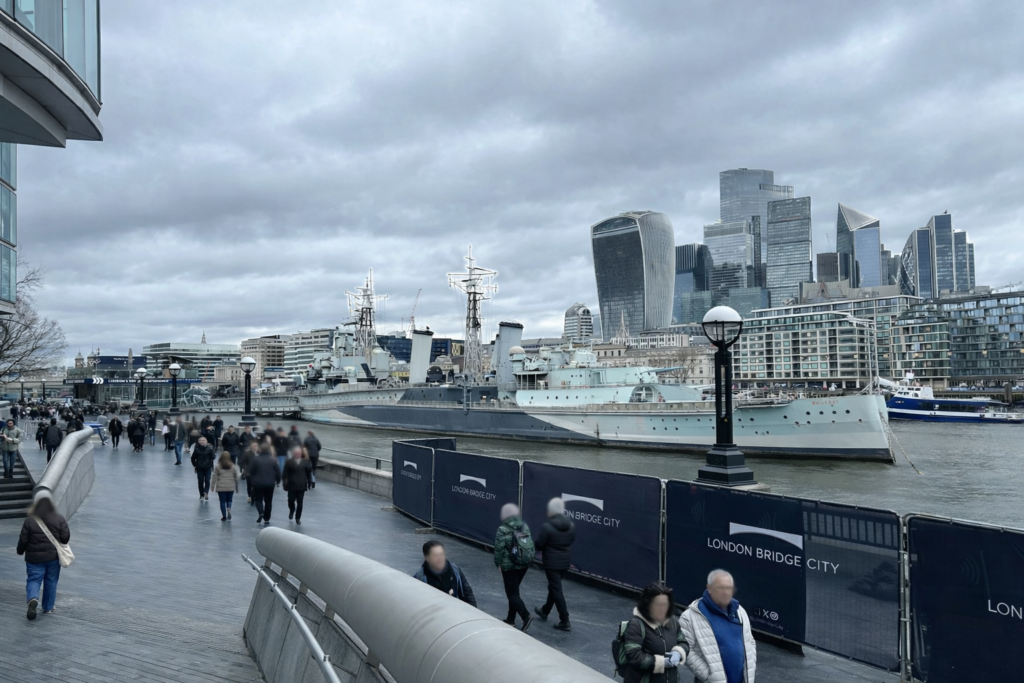
For this reason, the Tower of London is not suited for a hasty visit. When planning a visit, it is advisable to purchase tickets in advance from the official website, not only to avoid long queues but also to secure a more reasonable price than on-site purchases. The location is very accessible, just a short walk from Tower Hill station; for a more gradual approach, one might stroll along the Thames from London Bridge, allowing the castle walls to slowly come into view. Allocate at least three hours for the visit, or risk leaving with only fragmented impressions. Once inside, do not rush to see the jewels; instead, participate in a Yeoman Warder tour to quickly establish historical context and hear numerous details behind the institution. Inside the White Tower, rather than merely observing the armor, pay attention to the evolution of weaponry across different eras, as it concretely illustrates how state violence has evolved alongside institutional changes. Lastly, remember to wear comfortable shoes and prepare for windy and chilly weather, as this is a medieval fortress that does not compromise for tourists.

The Tower of London is worth entering for every visitor not because of its antiquity, but because it refuses to embellish history. It stands quietly, reminding you of how power once existed in its raw form, long before the advent of democracy and the rule of law. Any institution that considers itself secure should occasionally look back at this cold castle.

The Tower of London: A Symbol of Power and History Read More »

Don't Look Up: Humanity's Choices in Crisis

Don’t Look Up: Humanity’s Choices in Crisis

The film “Don’t Look Up” superficially presents itself as a black comedy or tragedy about an asteroid colliding with Earth. However, the true discomfort lies not in the celestial threat but in humanity’s response patterns when faced with clear crises. The film repeatedly reminds viewers that the issue is not one of ignorance, but rather the choice to disregard what is known.

Many have pointed out that the asteroid serves as a metaphor for climate change. Its trajectory is clear, the data has been repeatedly verified, and the timeline is already laid out in models, yet it is persistently delayed, downplayed, and politicized. Much like global warming, the problem has never been a lack of evidence but the stark reality of the costs associated with acknowledgment.

When the two astronomers first enter the White House and clearly outline the timeline and probability of the asteroid’s impact, there is no scientific controversy left. The data is consistent, the models align, and even uncertainties have been accounted for. Yet the first question from political figures is not how to respond, but whether discussing it will affect their electoral prospects. This scene is not exaggerated; it starkly presents a reality: within power structures, the severity of a crisis often must first be filtered through political costs. It is not a matter of misunderstanding but of inconvenient truths.

This distortion is further amplified in the media landscape. When scientific warnings are brought to morning talk shows, rational discourse is quickly consumed by the show’s rhythm. “Don’t be too heavy,” and “Viewers don’t want to hear this first thing in the morning,” lead to the end of the world being packaged as palatable entertainment. When a female scientist breaks down emotionally and cries out, the content of her message becomes secondary; what matters is that she has “lost her composure.” The film’s satire here is chillingly calm: in a media environment that prioritizes emotional management, the validity of facts is often overshadowed by whether the speaker is deemed “appropriate.”

Ironically, when there is already a viable plan with a high success rate to mitigate the crisis, the decision is easily rewritten by a tech billionaire. In his narrative, the asteroid is no longer a threat to be destroyed but rather an untapped source of immense wealth; risk is no longer a disaster to be avoided but a probability to be embraced in the innovation process. The original goal of “saving the planet” is suddenly transformed into a grand scheme of “making a fortune on the side.” As for what happens in the event of failure, it is cleverly obscured, as if simply not stating it clearly will prevent the consequences from occurring. The film mocks not only greed but also a profound arrogance that believes capital and technology can transcend risk itself—an attitude frequently observed in climate policy.

As time progresses, the asteroid becomes visible to the naked eye, no longer requiring telescopes, yet denial enters a new phase. “Don’t look up” becomes not just a slogan but a marker of political identity. As long as leaders say there is no need to look, supporters learn to avert their gaze. At this moment, the film’s focus transcends a single issue, pointing to a more universal phenomenon: when facts conflict with positions, people often choose to protect their stance rather than correct their understanding. It is not that the evidence is unclear; rather, clarity itself becomes unacceptable.

In the end, the world is not saved. There are no heroes to reverse the situation, no miracles to be found. All that remains is an ordinary dinner, where a group of people acknowledges their powerlessness and finally stops deceiving themselves. This scene is poignant precisely because it stands in stark contrast to all previous political performances, media noise, and technological fervor. When all grand narratives collapse, humanity briefly returns to honesty.

The sharpest satire of “Don’t Look Up” lies not in its depiction of a foolish world but in its portrayal of a reality where rationality is systematically suppressed. Here, people are not indifferent due to a lack of evidence; rather, they are paralyzed by the clarity of the evidence, which compels them to change their lives, challenge power, and bear the costs.

As the film concludes, the asteroid arrives as expected. This is not a conclusion but a question: when real-life “asteroids”—be they climate change or other imminent crises—repeatedly loom above us, do we truly not see them, or have we learned to choose not to look up under the guidance of power and money?

Don’t Look Up: Humanity’s Choices in Crisis Read More »

UK Special Education Spending Fails to Improve Quality

The core issue lies in the Education, Health and Care Plan (EHCP). This legally binding individual support plan mandates local governments to provide specified services once approved. Over the past decade, the number of students with EHCPs has surged from approximately 240,000 to over 570,000. Funding for these high-cost cases, known as the High Needs Block, has exceeded £10 billion, resulting in significant deficits for many councils.

The rising demand has its context, but the system simultaneously creates perverse incentives. Mainstream schools face financial pressures; if they absorb the support costs themselves, the burden falls entirely on them. However, if a student secures an EHCP, part of the expenditure can be covered by the High Needs Block. Consequently, referrals become a rational choice, leading to an increasing number of statutory cases.

Legal procedures further exacerbate conflicts. If parents disagree with the arrangements, they can appeal to the Special Educational Needs and Disability Tribunal. The success rate for these appeals has long hovered around 90%. As a result, local governments tend to resist, while parents are inclined to fight for their rights, leading to resource consumption in assessments and litigation rather than in teaching itself. Those who are more familiar with the system gain the upper hand.

The supply side is equally imbalanced. There is a shortage of public special schools, forcing local governments to purchase places from private institutions, with some charging between £60,000 and £100,000 per student annually. Cross-district placements are common, which increases transportation costs. Some students require one-on-one taxi services, which can cost up to £20,000 per year. A portion of the education budget is effectively spent on transportation.

Early support has been cut, resulting in problems accumulating until an EHCP application is necessary for resolution. The budgets for health, education, and social welfare are siloed, each operating independently. Population mobility further exacerbates pressures in certain areas.

Overall, there is a mismatch of incentives. Schools have a referral incentive, parents have an appeal incentive, providers have a price increase incentive, and local governments have a delay incentive. Each party acts rationally, yet the outcome is costly and inefficient.

To enact change, discussions cannot solely focus on increasing funding or cutting budgets. It is essential to address the root causes.

UK Special Education Spending Fails to Improve Quality Read More »

The High Cost and Future Potential of Floating Wind Power

In the latest round of Contracts for Difference (AR7) auction in the UK, the winning bid for floating offshore wind power remains significantly higher than that for fixed-bottom installations, exceeding it by more than double. At 2024 prices, fixed offshore wind power is approximately £90/MWh, while floating wind power stands at around £216/MWh. At first glance, this appears to be an economically unviable policy choice. However, when viewed through the lenses of physical fundamentals, power system operations, and long-term industrial strategy, floating wind power can be seen as a deliberate upfront investment rather than merely an expensive electricity purchase.

To begin with the most basic physical principles, the available power from wind generation is proportional to the cube of wind speed. A mere 10% increase in wind speed can theoretically yield a 30% increase in electricity generation. The key advantage of floating wind power lies not in the efficiency of individual turbines but in its ability to deploy wind farms in deeper and more distant waters, where winds are stronger, more stable, and turbulence is reduced, resulting in a higher capacity factor. This cubic relationship dramatically amplifies the value of high-quality wind sites, providing a clear and solid physical basis for floating wind power to ‘catch up with or even surpass’ fixed-bottom costs in the long term.

So why is it still so expensive at this stage? The reason lies not in physical limitations but in engineering and scale. Floating wind power requires additional floating structures, mooring and anchoring systems, dynamic cables, and more complex design validation and construction arrangements. In contrast, fixed offshore wind power has undergone over a decade of scaled development, resulting in a mature supply chain and standardized engineering practices. Floating wind power, however, is still in the early stages of industrialization, with fewer projects, dispersed designs, and high financing costs, leading to naturally higher electricity prices. This situation is strikingly similar to that of fixed offshore wind power over a decade ago.

Another pragmatic reason for the UK’s early investment is the geographical and resource limitations. Fixed offshore wind power relies on relatively shallow seabeds, and suitable nearshore sites for construction are not infinite. To continue significantly expanding zero-carbon electricity after the 2030s, new wind energy resources will primarily come from deeper waters, such as the Celtic Sea between southwestern England and Ireland, as well as the offshore regions along Scotland’s west coast and the Atlantic edge. Without floating technology, the vast wind energy resources in these areas would be nearly impossible to exploit, and the expansion of the UK’s offshore wind power would soon hit a natural ceiling.

From the perspective of the power system, deploying some wind capacity in further offshore areas with different climatic characteristics also enhances overall supply resilience. Deepwater wind farms are less affected by land friction, have higher average wind speeds, and their variations are not fully synchronized with those of nearshore and onshore wind farms in the North Sea. This spatial dispersion effect can significantly reduce the frequency and severity of simultaneous low-wind periods across large areas, resulting in a smoother overall output curve and reducing reliance on gas backup and short-term storage. These system-level benefits may not be directly reflected in the winning bid prices of individual projects but will gradually emerge in the risk and cost structure of the entire power system.

At the same time, floating wind power carries a clear vision for industry and exports. Fixed offshore wind power is already highly mature, with intense supply chain competition, leading to a dilution of added value. In contrast, floating wind power is still in its formative stage, with many engineering and standards yet to be finalized, including platform structures, mooring solutions, dynamic cables, and port and vessel support. This presents an opportunity for the UK to smoothly transition the offshore design, construction, and professional service capabilities accumulated during the North Sea oil and gas era into the zero-carbon industry. As technology matures in the 2030s, the UK not only can use these solutions domestically but also has the potential to export a complete floating wind power solution to other deep-water countries, establishing a long-term and high-value export advantage.

Many energy research institutions and engineering consultants also point out that the high costs of floating wind power are not a long-term state. As installed capacity expands, platform designs become standardized, and supply chains and port infrastructure take shape, coupled with a decrease in financing costs driven by reduced technical risks, the generation costs of floating wind power are expected to decline significantly in the 2030s. More optimistic industry roadmaps even anticipate that, after large-scale deployment, the electricity prices for floating wind power could drop to the range of £50–£100/MWh; even under more conservative assumptions, a gradual decline towards £100/MWh is widely expected, aligning more closely with mature fixed offshore wind power. In other words, the contracts that seem expensive today are more like an entry fee for the next cost leap.

In summary, while floating wind power may appear ‘more than double the price’ today, it is actually paying upfront costs for greater wind energy resources, a more stable power system, and an industry pathway with export potential. For the UK, the question has never been whether it is the cheapest option today, but whether, without investment today, there will still be choices ten years from now.

The High Cost and Future Potential of Floating Wind Power Read More »

The Flexibility and Logic of Parking in Britain

Upon arriving in the UK, many newcomers often wonder why roadside parking spaces are not clearly marked with white lines, despite the apparent availability. Frequently, the remaining space is insufficient for a vehicle, leading to wasted potential. This situation is common and raises the question: is the absence of markings truly reasonable?

In fact, the UK does not intend for roadside parking to be viewed as ‘allocated spaces.’ On most residential streets, roadside parking is considered a continuous use area rather than a segmented resource. As long as there are no yellow lines, no obstructions to entrances, and no impact on intersection safety, parking is legally permissible. The system assumes not that ‘each car has a space,’ but rather that ‘everyone adjusts according to the actual situation.’

This approach is grounded in practicality. While marked spaces may seem orderly, fixed parking lengths often accommodate larger vehicles; a smaller car parked in such a space leaves unused gaps. Without markings, vehicles can theoretically arrange themselves according to their lengths. Academic research and simulations indicate that in areas with a higher proportion of smaller cars, unmarked roadside parking can sometimes accommodate more vehicles, although this heavily relies on driver behavior.

However, the reality is that humans are not algorithms. Sometimes, a space may be insufficient for parking, resulting in fragmented areas that appear wasted. Yet, the system itself allows for such imperfections in exchange for lower costs and greater flexibility. Moreover, given the age and varying widths of British streets, comprehensive marking would not only be costly but could also lead to a more rigid use of space, potentially reducing parking capacity.

Furthermore, this practice is not unique to the UK. Countries such as Ireland, France, Belgium, Italy, and even the Netherlands’ historic districts still extensively utilize unmarked roadside parking. In contrast, Germany, Japan, Switzerland, Hong Kong, and Singapore employ a different logic: the absence of clear markings equates to a prohibition on parking. These two systems reflect not a right or wrong, but differing orientations.

Nonetheless, the UK is not static. In recent years, there has been an increase in white lines in city centres, new development areas, near railway stations, and in paid parking and resident permit zones. The reason is not aesthetic; it is due to high demand, the need for regulation, and the convenience of enforcement. In simple terms, areas that require management will have markings, while older residential streets retain their flexibility.

Finally, a practical legal point: in the UK, the determination of whether a vehicle is ‘on the yellow line’ does not depend on the body of the car or the entire wheel, but rather on the contact point between the tire and the ground. As long as the part of the tire making contact with the ground does not cross the yellow line, even if the front or rear of the vehicle extends beyond it, it is not legally considered a violation. Many new immigrants are initially unaware of this detail.

Thus, while roadside parking in the UK may appear disorganized and sometimes waste space, it offers flexibility, low costs, and a ‘no prohibition means permission’ logic. Once accustomed to it, one might find it quite quintessentially British.

The Flexibility and Logic of Parking in Britain Read More »

Wealthy Yet Short-Lived: The American Life Expectancy Paradox

When measuring a country’s achievements, GDP is never the final destination. The true bottom line is how long people live. When examining this indicator, the United States’ performance is strikingly disproportionate to its wealth status.

First, let’s look at the numbers. The life expectancy at birth for American men is around 75 to 76 years; in contrast, men in other high-income countries such as the UK, Germany, France, and Japan generally live between 79 and 81 years. For women, the life expectancy in the U.S. is approximately 80 to 81 years, while Western Europe averages between 83 and 85 years, and Japan reaches 86 to 87 years. In both genders, the U.S. lags significantly behind its peers, with the gap for men being particularly pronounced, further dragging down the overall life expectancy.

This discrepancy is not due to insufficient healthcare spending. On the contrary, the U.S. boasts the highest healthcare expenditures among OECD countries. In recent years, American healthcare spending has accounted for about 17 to 18% of GDP, far exceeding the 9 to 12% typical of other developed nations. In other words, the proportion of GDP the U.S. allocates to healthcare is nearly double that of some countries, yet it fails to yield corresponding life expectancy outcomes.

The issue lies not in how much is spent, but in how it is spent. The U.S. still lacks a universal healthcare system, leaving tens of millions without any health insurance, while many more have only nominal coverage. Access to medical care depends on employment status and insurance terms. Under this system, illness is not merely a health issue but also a financial risk.

More critically, even with insurance, coverage does not guarantee security. Insurance denials are not uncommon in the U.S., with various technical reasons frequently cited. For the average person, the appeals process is complex and costly, often requiring time, expertise, and even legal support. Consequently, most individuals choose to forgo pursuing claims or are simply too afraid to seek medical help. Over time, the choice to ‘avoid getting sick’ becomes a rational decision.

This is directly reflected in mortality statistics. Numerous studies indicate a significant proportion of avoidable deaths in the U.S.: people do not die from medical impossibilities but rather due to delayed treatment, chronic diseases that cannot be managed over the long term, or the fear of bills that prevents them from visiting emergency rooms during crises. During the pandemic, the mortality rate among uninsured populations was significantly higher, a trend that is not incidental but rather a systemic inevitability.

Even in the absence of immediate death, the healthcare system continues to erode life expectancy. Chronic diseases such as cardiovascular disease, diabetes, and kidney disease, which require stable follow-up, typically imply long-term coexistence in countries with universal healthcare. In the U.S., however, these conditions often spiral out of control due to insurance lapses, denials, or prohibitively high out-of-pocket costs, ultimately leading to premature death.

Ironically, the U.S. does not lack cutting-edge medical technology. It leads the world in advanced treatments, drug development, and specialized medicine. However, longevity is never achieved through the most expensive technologies; it is built on accessible, stable, and affordable basic healthcare. A system that invests substantial resources upstream while imposing heavy barriers at the entry point is destined to be inefficient.

The lag in life expectancy indicates that the issue is not that America is insufficiently wealthy, but rather that there is a fundamental imbalance in institutional choices. When healthcare spending approaches one-fifth of GDP yet still allows people to die prematurely due to insurance issues, denials, and bills, the societal cost incurred far exceeds what any fiscal numbers can explain.

Wealthy Yet Short-Lived: The American Life Expectancy Paradox Read More »

Complete the Settlement Consultation in Five Minutes

The government has proposed an “earned settlement” scheme, which may alter the thresholds and principles of the current settlement pathway. This consultation is not merely a formality; it represents a significant direction. Silence, to some extent, equates to acquiescence.

The consultation will conclude on February 12, 2026 (Thursday). I urge everyone to take five minutes to fill it out; the link is in the first comment.

You do not need to answer every question. If you are unsure, you may leave it blank or choose “Don’t know / prefer not to say.” The act of filling it out itself represents a stance.

If you find you cannot complete the form (for instance, if a household member has already submitted it), you can switch to your mobile personal hotspot, use public Wi-Fi, or enable a VPN.

Below are my responses to specific questions for your reference. The guiding principle is simple: uphold existing commitments and oppose retroactive changes.

Overall, how clear do you find the proposed changes to the settlement framework? Neither clear nor unclear (to prevent the Home Office from filtering out unclear responses).

Are there any other groups that you think should be exempt from the requirement to have earned above £12,570 for at least 3 to 5 years? BN(O) status holders and their family members.

To what extent do you agree or disagree that once someone has been granted settlement in the UK, they should be eligible to claim public funds (e.g., benefits and housing assistance)? Strongly agree.

To what extent do you agree or disagree that there should not be transitional arrangements for those already on a pathway to settlement? Strongly disagree.

Are there any other vulnerable groups that you think should be considered as part of this consultation? BN(O) status holders and their family members.

To what extent do you agree or disagree that dependent partners of migrants should earn settlement in their own right? Strongly disagree.

To what extent do you agree or disagree that dependent children of migrants should earn settlement in their own right? (with employment-related requirements waived if they were admitted as a dependent under 18) Strongly disagree.

Do you have any further comments on how specific groups should be considered in relation to settlement? We particularly welcome views on how the proposed changes could affect children in the UK. BN(O) status holders and their families should be exempt from the proposed “earned settlement” scheme, in the same way as those under the EU Settlement Scheme. The BN(O) route was established as a clear humanitarian pathway to settlement, reflecting the UK’s historical and moral obligations to Hong Kong, and it should not be altered.

Settlement should not become a temporary commitment, nor should it be retroactively intensified.

If you have opinions, you must voice them.

If you have rights, you must exercise them.

Please spread the word and remind those around you to fill it out together.

The link is in the first comment. #BNO #UKPolicy #Settlement #Immigration #Consultation

Complete the Settlement Consultation in Five Minutes Read More »

Scroll to Top