UK Affairs

UK Electricity Is the Cheapest in Europe — If You Know How to Use It

UK Electricity Is the Cheapest in Europe — If You Know How to Use It

When people talk about British electricity bills, the conversation usually goes one way: expensive. The Ofgem price cap sits at nearly 25p per kilowatt-hour, higher than Hong Kong, France and Spain. That figure is accurate, but using it to compare electricity costs across countries is a fundamental misreading of how the UK energy market works.

Britain’s electricity market has been fully liberalised since the 1990s and is among the most open retail energy markets in the world. Households are free to choose their supplier and tariff — the Ofgem price cap exists solely to protect consumers who never actively shop around, not to represent the best available option. Treating the cap as a proxy for “UK electricity prices” is like using the most expensive item on a supermarket shelf to represent what people actually pay for groceries.

Households who understand the market pay 5.5p per kilowatt-hour for overnight electricity between 23:30 and 5:30 — the confirmed rate from 1 April for new customers on Octopus Energy’s Intelligent Go (IOG) tariff. Existing customers, depending on region and tariff version, can pay as little as 3.49p to 5.2p per kilowatt-hour. Put these numbers alongside the rest of Europe and they become almost implausible: France’s cheapest fixed off-peak rate (Heures Creuses) sits at around 13p, Germany at 15–18p, Spain at 14–18p, and even Norway — famous for its cheap hydropower — sees households paying 10–12p per kilowatt-hour overnight once VAT and grid fees are included. On the measure that actually matters — the all-in price a consumer pays during fixed overnight hours — IOG is the cheapest in Europe, without exception.

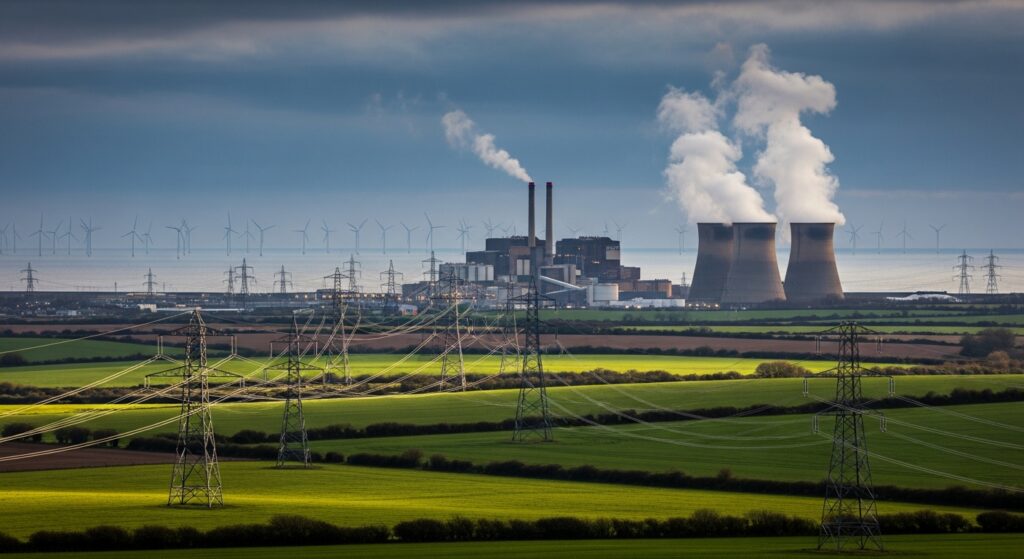
This is not a government subsidy. Octopus uses artificial intelligence to coordinate the charging of over 150,000 electric vehicles, absorbing surplus electricity from the grid during the small hours when demand is lowest and generation is highest. The structural oversupply of overnight electricity — driven largely by Britain’s rapidly expanding offshore wind fleet, the largest in Europe — becomes a direct benefit to customers, while simultaneously helping to balance the grid. It is a privately funded virtual power plant, built on market design rather than public money.

IOG is specifically designed for households who can charge an electric vehicle at home. Those without home charging — whether renting, without a driveway, or simply not yet EV owners — are not without options. Octopus’s Cosy tariff offers heat pump owners several fixed cheap slots each day. The Agile tariff passes through half-hourly wholesale prices directly to customers, meaning that during periods of high wind or excess solar generation, the rate can fall close to zero or even turn negative. E.ON, EDF and other suppliers offer their own competitive overnight tariffs. The market is genuinely competitive, and the options extend well beyond a single product.

Whichever tariff a household chooses, a home battery system increasingly makes the economics even more compelling. As LFP battery technology has matured, prices have fallen sharply. A 10–16 kilowatt-hour home battery with inverter can now be supplied and installed for a few thousand pounds. Charged overnight at the cheapest tariff rate and discharged during the day, the system effectively replaces daytime grid electricity — bought at around 25p — with overnight electricity bought at a fraction of that price. At 5.5p overnight against 25p daytime, payback periods of four to six years are achievable, against a battery lifespan of fifteen years or more.

Britain does not have France’s nuclear fleet or Norway’s mountain reservoirs. What it has is wind — abundant, structural, and growing — and a market architecture designed to translate that resource into tangible savings for engaged consumers. The question was never whether UK electricity is expensive. The question is whether you have taken the time to understand your choices.

UK Electricity Is the Cheapest in Europe — If You Know How to Use It Read More »

Spain and Italy Took Different Paths on Energy. The Results Are In.

Spain and Italy Took Different Paths on Energy. The Results Are In.

In 2019, Spain and Italy stood at roughly the same starting point. Both countries had similar shares of renewables in their electricity mix, and both relied heavily on natural gas to set the wholesale price. In the years that followed, they made sharply different choices. Looking back now, this is not merely a policy comparison — it is one of the clearest natural experiments in European energy history.

Spain accelerated. Over the past five years, it added more than 40 gigawatts of wind and solar capacity, more than any EU country except Germany, whose electricity market is nearly twice the size. By 2024, renewables accounted for around 57% of Spain’s electricity generation. More importantly, the share of hours in which gas set the wholesale price fell from 75% in 2019 to just 19% by 2025. Spain’s electricity price has, to a significant degree, decoupled from the volatility of global gas markets. The Bank of Spain estimates that wholesale prices would have been around 40% higher today had wind and solar capacity remained at 2019 levels.

Italy took the opposite route. Its share of renewables has grown modestly, but gas has retained — and in some respects tightened — its grip on the electricity system. Italy’s foreign energy dependence stands at roughly 75%, the highest among major European economies. That structural reliance on imported gas means Italian power prices remain acutely sensitive to any disruption in supply or spike in commodity markets. In the first four months of 2025, Italy’s average wholesale electricity price reached €136 per megawatt-hour, compared to €81 in Spain — a gap of nearly 70%. This is not a temporary divergence. It is a structural one.

The consequences extend well beyond household electricity bills. Energy costs are a direct input into industrial competitiveness. Spain’s manufacturing sector has benefited visibly from cheaper power, while Italian industry continues to absorb costs that its Spanish counterparts no longer face at the same scale. Energy policy, in this sense, quietly rewrites a country’s industrial geography.

The underlying logic is not complicated. European electricity markets are priced at the margin — the most expensive generator operating at any given hour sets the price for everyone. As wind and solar flood the grid with low-cost electricity, gas-fired plants are pushed further to the margins, setting the price less often. Spain has exploited this mechanism deliberately and at scale. Italy has not, and continues to pay accordingly.

Spain is not without its own vulnerabilities. Grid investment has lagged badly behind the pace of renewable buildout — during the five years to 2024, Spain spent just 30 cents on grid infrastructure for every euro invested in renewables, against a European average of 70 cents. A major blackout in April 2025 laid bare the consequences, with balancing costs spiking sharply in the months that followed. The problem, however, is one of infrastructure rather than direction of travel. It has solutions. Italy’s predicament is more fundamental.

For the United Kingdom, this story is not a distant one. Britain possesses some of the finest offshore wind resources in the world and could, in principle, have followed a trajectory closer to Spain’s. Instead, the 2023 AR5 offshore wind auction ended with zero bids from the sector after the government refused to raise the administrative strike price cap despite surging construction costs. Given the typical three-to-four-year build timeline for offshore wind projects, the capacity that should have been secured in that round would have been coming online in 2026 and 2027 — precisely now. What was lost was not abstract future capacity. It was electricity that British households and businesses would already be using. The cost of that decision continues to be paid, quietly, on every energy bill.

Spain and Italy Took Different Paths on Energy. The Results Are In. Read More »

Saving Developers, Costing Everyone: The Thirteen-Year Delay in Britain's Zero-Carbon Homes

Saving Developers, Costing Everyone: The Thirteen-Year Delay in Britain’s Zero-Carbon Homes

In March 2026, the UK government formally announced the details of the Future Homes Standard, requiring all new homes in England where construction begins after March 2028 to be fitted with rooftop solar panels covering the equivalent of at least 40% of the building’s floor area, alongside low-carbon heating systems such as heat pumps and significantly improved insulation. The government estimates that homes built to the new standard will save households up to £830 a year on energy bills and produce more than 75% less carbon than those built under the 2013 regulations. The announcement is welcome. But it invites an equally important question: why are we only getting here now?

The answer begins in 2006, when Gordon Brown, then Chancellor of the Exchequer, announced that Britain would become the first country in the world to require all new homes to meet a zero-carbon standard. From 2016, every new dwelling would need to generate as much energy on-site — through solar, wind, or other renewables — as it consumed in heating, hot water, lighting and ventilation, supported by tighter fabric efficiency requirements. The housebuilding industry had nearly a decade to prepare.

It never happened. In July 2015, with just months to go before implementation, Chancellor George Osborne quietly scrapped the policy in a productivity document titled Fixing the Foundations, citing the need to reduce the regulatory burden on developers. Housebuilders, planners and green groups condemned the decision, but it stood. Property developers have long been among the most significant donors to the Conservative Party, and the structural relationship between the industry and the party ensured that the lobbying pressure to relax building standards never fully abated.

Cancelling a building standard does not eliminate costs. It merely shifts them — to a later date, and to different people. Meeting zero-carbon requirements at the point of construction would have added roughly 1 to 2% to the cost of a new home, recoverable through energy bill savings within a few years. Retrofitting an existing home to an equivalent standard, by contrast, is estimated to cost between £17,000 and £24,000 per household — three to five times more expensive. And that is when retrofitting is even possible.

In practice, retrofitting is often far from straightforward, and sometimes not feasible at all. Gas boilers and heat pumps operate on fundamentally different principles: boilers drive water at high temperatures through narrower pipes, while heat pumps work at lower flow temperatures and require wider pipework to deliver equivalent warmth. This means that the existing pipe network in a gas-heated home is frequently inadequate for a heat pump, necessitating partial or complete replacement. Some pipework may need to be rerouted along external walls, raising both cost and aesthetic concerns. In many cases, installing an outdoor heat pump unit or modifying external walls requires planning permission — a process that is uncertain in outcome and often prohibitive in conservation areas or listed buildings. Where the layout of a home simply does not accommodate the space or structural changes required, retrofitting may be technically impossible regardless of budget. Getting it right in the first place and trying to correct it afterwards are not the same problem.

Developers, for their part, were not as shrewd as they imagined. A new home built with a heat pump from the outset requires no gas connection at all — eliminating the cost of laying pipework to the property entirely. More significantly, the UK will eventually need to decommission its gas network. The cost of dismantling and retiring that infrastructure will fall on whoever is still using it. Every new home connected to the gas grid today is adding to the size of a system that society will one day have to wind down. Developers saved themselves a modest upfront cost and passed a far larger long-term burden onto households and the public.

The scale of that burden is not abstract. The Energy and Climate Intelligence Unit has estimated that by the end of 2020, the cumulative cost of the additional energy wasted by homes built without zero-carbon standards since 2016 exceeded £2 billion. Occupants of new homes built from the start of 2016 are expected to pay nearly £3,000 more in heating costs by 2030 than they would have under the cancelled policy. The government itself has acknowledged that more than one million homes were built to substandard specifications following the 2015 decision, leaving their occupants exposed when energy prices surged after Russia’s invasion of Ukraine in 2022.

But the consequences of higher gas demand do not fall only on those in new-build homes. Gas is a unified market: more demand means higher prices, and higher prices are paid by everyone. Millions of homes that should have been built to higher efficiency standards continue to draw on the gas network, keeping aggregate demand — and prices — elevated across the board. The conflict in the Middle East has again demonstrated how structurally exposed the UK remains to global energy markets. When Energy Secretary Ed Miliband announced the Future Homes Standard, he was explicit: breaking dependence on fossil fuel markets is the only durable protection against geopolitical price shocks. The energy efficiency of Britain’s housing stock is not a private matter between homeowners and their utility bills. It is a systemic risk shared across the entire economy.

The Future Homes Standard is a correction, and a necessary one. But its reach is limited to homes not yet built. Britain’s existing housing stock is among the oldest and least energy-efficient in Europe, and the path to retrofitting it is expensive, technically constrained, and in many cases blocked by the design of the homes themselves. The standard announced this week fills a gap that should never have existed. A decision taken in 2015 under the banner of deregulation has cost Britain thirteen years, shifted billions of pounds from developers’ construction budgets onto household energy bills, and locked a generation of homeowners into a problem that, for some, may never be fully solved.

Saving Developers, Costing Everyone: The Thirteen-Year Delay in Britain’s Zero-Carbon Homes Read More »

Drill, Baby, Drill? Why the North Sea Tax Revenue Argument Doesn't Add Up

Drill, Baby, Drill? Why the North Sea Tax Revenue Argument Doesn’t Add Up

Conservative leader Kemi Badenoch, shadow energy secretary Claire Coutinho, and Reform UK’s Nigel Farage have all been vocal in calling on the government to reopen North Sea oil and gas drilling. Coutinho claimed on social media that Labour is turning down £25 billion in tax revenue by blocking new licences. Badenoch put it more bluntly: drilling in the North Sea is the answer to the energy crisis.

Intuitively, the argument has appeal. The North Sea genuinely was a fiscal goldmine for the UK. Since commercial production began in the 1970s, revenues peaked at over £12 billion in 1984-85, representing more than 3% of GDP. They hit a fresh cash high of £12.4 billion in 2008-09, and surged again to £9 billion in 2022-23 as the Ukraine war drove up energy prices and the then-Conservative government introduced the Energy Profits Levy. Over fifty years, the North Sea contributed well over £300 billion to the Treasury. The claim that North Sea oil built British prosperity is not wrong.

The problem is that this is the North Sea of fifty years ago, not today’s.

The basin was once rich enough that drilling almost anywhere yielded results and the tax base was enormous. Today it is an ageing basin with around 90% of its reserves already extracted. Production stands at roughly a fifth of its 2000 peak and continues to fall. The Office for Budget Responsibility projects that North Sea tax revenues will drop from around £6 billion in 2024-25 to just £100 million by 2030-31. That trajectory was locked in long before Labour took office.

More paradoxically, issuing new licences would actually reduce tax revenues in the short term. This follows from a fiscal mechanism that rarely gets mentioned. Under the current UK regime, oil and gas companies enjoy up to 91% tax relief on new investment, across ring-fence corporation tax, the supplementary charge, and the investment allowances within the Energy Profits Levy. Every new licence triggers large upfront capital expenditure that can be immediately offset against tax liabilities. New licences generate more tax deductions, not more tax receipts.

The long-term picture is worse still. When a field reaches the end of its life, the operator must decommission it — a costly process. The North Sea Transition Authority estimates the total decommissioning bill for existing UK infrastructure at £41 billion. Under UK tax law, companies can carry back decommissioning costs almost indefinitely against past profits, triggering repayments to the Treasury. HMRC estimates the total cost to the public purse at around £11.7 billion in present value terms. The profits go to private companies; the closure bill falls on taxpayers. Analysis of proposed new fields such as Rosebank suggests that once all tax reliefs and decommissioning liabilities are factored in, the net fiscal benefit to the UK could be negative.

On energy bills, the Conservative and Reform argument is equally unconvincing. Once extracted, oil and gas are sold at international market prices. North Sea output is far too small to move global prices. Even Coutinho herself, when she was Energy Secretary in 2023, admitted that new licences would not necessarily bring energy bills down.

Addressing the energy crisis is not a question of squeezing more supply from an exhausted basin. The more durable answer lies in reducing demand for oil and gas in the first place. Solar and wind power are not priced by events in the Middle East. The more households switch from gas boilers to heat pumps, and from petrol cars to electric vehicles, the less exposed the country becomes to volatile fossil fuel markets. Drilling in the North Sea would not lower bills, would reduce tax revenues in the short term, and would ultimately transfer decommissioning liabilities onto the public. The question worth asking is not whether to drill — but why.

Drill, Baby, Drill? Why the North Sea Tax Revenue Argument Doesn’t Add Up Read More »

A Decade of Patching, and the Holes Keep Growing: The Real Reason Britain's Roads Are Falling Apart

A Decade of Patching, and the Holes Keep Growing: The Real Reason Britain’s Roads Are Falling Apart

How bad are Britain’s roads? According to the annual road maintenance survey published by the Asphalt Industry Alliance, a pothole has been filled somewhere in England or Wales every eighteen seconds, every day, for the past ten years. The result? The condition of the network has not improved. The backlog of repairs has swelled from several billion pounds a decade ago to nearly £19 billion today. In other words, after all that spending and all those filled holes, Britain’s roads have gone from bad to worse.

There are genuine physical reasons why potholes form. Britain’s wet climate and winters that hover around freezing create ideal conditions for road deterioration. Water seeps into surface cracks, freezes and expands, then thaws and contracts, gradually breaking the asphalt apart. Much of the road network was built in the mid-twentieth century, long before anyone planned for today’s traffic volumes or the weight of modern heavy goods vehicles. Age and weather are real factors. But they are background conditions, not explanations. Blaming the climate for the state of Britain’s roads is a way of avoiding a more uncomfortable answer. The real problem is not how much money has been spent. It is the nature of the money itself.

In England, motorways and major trunk roads are managed by central government. Everything else — the local roads that make up 99% of the total road network by length and carry around two-thirds of all vehicle miles — falls under the responsibility of local highway authorities, meaning local councils. The roads that most people actually use every day, to get to work, to school, to the shops, are maintained by councils whose budgets depend heavily on central government grants. And it is the structure of those grants that lies at the heart of the problem.

Road maintenance is inherently a recurrent expense. Resurfacing a road is not a one-off project — it is something that needs to happen on a regular cycle, not because something has gone wrong, but because road surfaces have a finite lifespan. The Asphalt Industry Alliance recommends resurfacing every ten to twenty years. The reality, according to its surveys, is that the average local road in England and Wales is resurfaced only once every ninety-three years. Most roads are not being maintained in any meaningful sense. They are simply being patched until they fail.

This has happened because successive governments have repeatedly reached for capital funding to address what is fundamentally a revenue problem. Capital grants are one-off allocations suited to building new infrastructure. Road maintenance, by contrast, requires stable, year-on-year revenue funding to sustain a proper resurfacing cycle. The two serve entirely different purposes. A capital grant can resurface a road this year, but when that same road begins to crack again two winters later, it falls back into the same chronically underfunded recurrent maintenance system. The underlying problem has not changed.

Nowhere was this confusion more visible than in 2023, when the Sunak government announced the cancellation of the northern leg of HS2, between Birmingham and Manchester, and declared that part of the redirected funds would be used to fix potholes across the country. The announcement was politically effective. Financially, it was a category error. HS2 was a capital infrastructure project, and its funding could not simply be converted into the recurrent maintenance budgets that councils actually need. Even where capital money was used to repair specific roads, those roads would continue to deteriorate within a system that still lacked adequate revenue funding. Capital spending can fill holes. It cannot fix the structural gap that keeps producing them.

The accountability problem runs alongside the funding problem. In a report published in early 2025, the Public Accounts Committee criticised the Department for Transport for providing over £1 billion annually to local authorities for road maintenance without ever setting clear outcome targets or evaluating what the money had achieved. Funds were distributed, roads continued to deteriorate, and no one in central government was required to explain why. This pattern repeated itself for years.

The current Labour government has signalled a change of approach. In late 2024 it announced a record £1.6 billion allocation for local road maintenance in 2025 to 2026, and committed to providing £7.3 billion over four years beginning in 2026 to 2027, giving councils the longer funding horizon they have long requested. Industry bodies have welcomed this cautiously, while noting that even if the commitment is delivered in full, clearing the existing backlog at current rates would still take well over a decade.

Britain’s pothole problem has never been a technical one. Engineers have always known how to maintain roads and how frequently it needs to be done. The problem is that the system has spent decades offloading responsibility onto local councils while supplying them with the wrong kind of money — one-off capital injections dressed up as solutions to what is, at its core, a recurrent funding deficit. Every politically-charged announcement of a new pothole repair fund has been, in effect, a way of packaging a structural failure as a deliverable. The cost of that failure is borne by every driver and cyclist who navigates the result — one pothole at a time.

A Decade of Patching, and the Holes Keep Growing: The Real Reason Britain’s Roads Are Falling Apart Read More »

Still Measuring in Stones: Why Britain Never Finished Going Metric

Still Measuring in Stones: Why Britain Never Finished Going Metric

For new arrivals in Britain, one of the earliest sources of confusion is not the language but the units. A hospital will record your weight in kilograms, yet your neighbour will ask how many stone you are. Milk in the supermarket is sold by the litre, but beer at the pub comes only in pints. This apparently chaotic dual system is not an accident or an oversight. It is the residue of half a century of incomplete reform, caught between the practical demands of modern trade and a stubborn attachment to cultural familiarity.

Britain’s commitment to metrication did not begin reluctantly. In 1965, the government formally launched a conversion programme, driven largely by industry’s need to align with European trading partners and compete in international markets. Progress in commercial and scientific contexts was substantial. When Britain joined the European Economic Community, EU directives accelerated the shift: pre-packaged goods such as sugar, flour, and meat were relabelled in grams and kilograms, and petrol was eventually sold by the litre. In these domains, metrication succeeded quietly and permanently.

The resistance came when reform moved into everyday life. For many ordinary people, metrication carried the flavour of bureaucratic imposition — a change handed down from officials and, later, from Brussels rather than one that emerged naturally from daily habit. The 1985 Weights and Measures Act mandated metric units for most retail transactions, but the government preserved key exemptions to soften public opposition. Road signs would stay in miles. Draught beer and cider would remain in pints. These carve-outs were presented as pragmatic concessions, but they had the effect of permanently institutionalising a two-tier system. By the 1990s, as the EU pushed harder for uniform standards across member states, what had begun as a technical question of measurement became a political flashpoint, seized upon by Eurosceptics as evidence of Brussels overreach into British daily life.

The contrast with the United States is instructive. America also attempted metrication in the 1970s but abandoned the effort almost entirely, leaving the country with a near-complete reliance on US customary units across both commerce and public infrastructure. Britain’s outcome sits somewhere in between. Science, finance, medicine, packaged food, and fuel are all fully metric. Roads, speed limits, pub measures, and body weight remain stubbornly imperial. This hybrid reflects Britain’s structural position as a country that cannot afford to be commercially isolated from a metric world, yet whose population retains strong intuitive associations with the older system.

The economics of full conversion remain daunting. Replacing tens of thousands of road signs and speed limit boards across the country would require significant public expenditure, and any transition period would carry genuine safety risks as drivers adjusted to unfamiliar units. Maintaining the status quo imposes its own costs in the form of constant mental conversion, but those costs are diffuse and individual rather than concentrated and visible. The result is a country where children learn metric in school but instinctively reach for miles and stones the moment they leave the classroom.

For readers more comfortable with metric units, the conversion is straightforward enough once learned: one stone equals 14 pounds, or approximately 6.35 kilograms. A person weighing 60 kilograms is just over 9 stone 6 pounds in the idiom most British people would naturally use. That a units system requiring its own vocabulary and arithmetic still governs something as personal as how people describe their own bodies says a great deal about how deeply measurement is woven into culture — and how difficult it is to uproot, even when the case for change is clear.

Still Measuring in Stones: Why Britain Never Finished Going Metric Read More »

Filing Five Times a Year on £20,000: What Is Making Tax Digital Actually For?

Filing Five Times a Year on £20,000: What Is Making Tax Digital Actually For?

Here is what you need to know first.

From 6 April 2026, HMRC will begin rolling out Making Tax Digital for Income Tax (MTD), requiring self-employed people and landlords to overhaul how they report their income. The first wave covers those with combined gross income from self-employment and property above £50,000, based on their 2024/25 tax return figures. The threshold drops to £30,000 in April 2027, and to £20,000 in April 2028. That last figure is gross income, not profit. A window cleaner turning over £20,000 but clearing far less after expenses will still be caught.

Under the new system, affected taxpayers must submit a quarterly update of income and expenses to HMRC, with deadlines falling on 7 August, 7 November, 7 February, and 7 May each year. A final declaration follows by 31 January. Five interactions with HMRC per year, where there was once one. Late submissions earn penalty points under a new points-based system, with a £200 fine triggered at four points. The first cohort joining in 2026 will receive a soft landing on quarterly penalties for their first year, though the final declaration deadline remains fully enforced.

General partnerships are not yet in scope. Limited companies fall under corporation tax and are unaffected. Non-UK residents required to complete the SA109 residence pages have been deferred to 2027 at the earliest.

To comply, you must register for MTD with HMRC before your mandation date, choose HMRC-recognised third-party software, maintain digital records of every transaction, and submit all updates through that software. There are a handful of free or low-cost options on the market, but these are commercial decisions that can be revised at any time.

Now here is what you should know.

HMRC used to operate a free official online filing service. Any taxpayer could log in, complete their Self Assessment return, and submit it directly to HMRC at no cost. No subscription, no third party, no annual fee. It was the tool most unrepresented taxpayers relied on. In the Spring Statement of March 2025, the government confirmed that this service will no longer be available to anyone within MTD. All submissions — quarterly updates and the annual final declaration — must go through commercial software. The government’s explanation was that the market would provide alternatives.

Think about what that means in practice. A private tutor. A delivery driver. A landlord with a single buy-to-let flat. From 2028, if their gross income crosses £20,000, they face four additional reporting obligations every year, a mandatory software subscription, and the administrative burden of learning a new system. Their tax bill has not changed. The date they pay has not changed. The only things that have changed are the compliance burden and the cost of meeting it.

HMRC’s stated justification is that more frequent reporting will reduce errors and close the tax gap — the difference between tax owed and tax collected. This argument has a narrow validity. Some taxpayers do make genuine mistakes when reconstructing a full year of transactions in a January rush. Quarterly records, kept in real time, may reduce those accidental errors. But the tax gap is not composed mainly of accidents. A significant portion comes from deliberate underreporting. Quarterly submissions do not change this at all. Someone who misreports their income annually can just as easily misreport it quarterly. The figures still come entirely from the taxpayer. HMRC’s existing Connect system, which cross-references bank data, Land Registry records, and other government databases, is what actually catches deliberate evasion. MTD has no connection to it and does nothing to strengthen it.

The frequency argument also collapses under its own logic. If quarterly reporting is more accurate than annual, monthly would be more accurate still, and weekly more accurate than monthly. Nobody advocates for weekly filing because everybody understands that would be absurd. The choice of quarterly is not derived from any theory of accuracy. It is the number the government judged it could impose without triggering overwhelming resistance.

The international comparison makes this clearer. In the United States, self-employed individuals make quarterly estimated tax payments to the IRS — actual money, paid in advance, because no employer is withholding on their behalf. The logic is sound. In several European countries, clients withhold a percentage directly from freelance invoices and remit it to the tax authority in real time. That too makes sense. MTD is neither. It requires quarterly reporting without quarterly payment. Tax is still collected once a year in January. The entire exercise produces data for HMRC earlier in the year than before. That benefits HMRC’s systems. It does not benefit the taxpayer in any material way.

The Chartered Institute of Taxation, the Low Incomes Tax Reform Group, and the Association of Taxation Technicians wrote jointly to the government raising exactly these concerns. They pointed out that some affected taxpayers earn too little to owe any tax at all, yet will be legally required to subscribe to commercial software to comply with a reporting mandate that changes nothing about their liability. The government responded by expressing confidence in the software market.

Trusting the market is what governments say when they have decided that someone else should bear the cost of their policy.

HMRC has shed the expense of maintaining a free filing service. Software companies have inherited a captive customer base delivered to them by law. Taxpayers are left with four times the reporting work, a new recurring expense, and no change whatsoever in what they owe. If MTD were genuinely about accuracy, HMRC would have invested in better data-matching. If it were genuinely about fairness, HMRC would have maintained a free filing option. What it has actually produced is a compliance infrastructure that serves the tax authority’s data appetite, costs the taxpayer money to operate, and leaves the software industry considerably better off than before.

Filing Five Times a Year on £20,000: What Is Making Tax Digital Actually For? Read More »

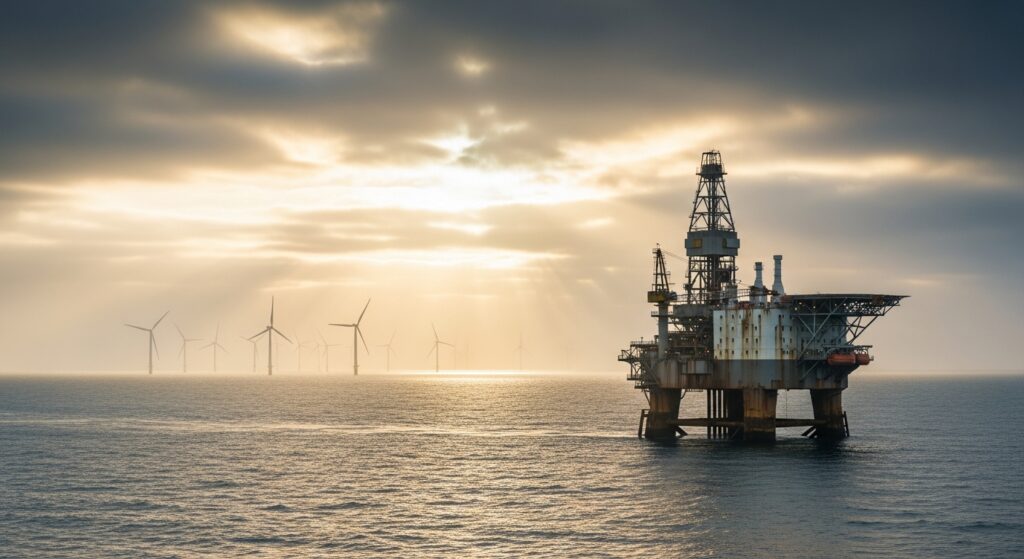
Deepsea Delta oil drilling rig operating in the North Sea

North Sea Oil at $110: The Case for New Drilling Still Doesn’t Add Up

Every time oil prices spike, calls to reopen North Sea exploration resurface. One point should be clear from the outset: domestic drilling will not lower the price at the pump. Oil is a globally priced commodity, and UK output is too small to move international markets. Proponents nonetheless put forward several arguments — that new exploration generates tax revenue, that the industry sustains tens of thousands of jobs across Scotland and beyond, and that domestically produced oil carries lower upstream and transport emissions than crude shipped from the Middle East. These arguments deserve to be taken seriously. But they do not answer the specific question this article examines: is new North Sea exploration financially viable under a genuinely no-subsidy regime, where operators must deposit the full decommissioning cost upfront before a single well is drilled?

The decommissioning deposit is not a procedural footnote. It is the mechanism that determines who ultimately bears the risk. Plugging and abandoning a well costs roughly $2.5–5 million; once associated infrastructure is included, the average rises to around $10 million per well. The total decommissioning liability across the UK Continental Shelf (UKCS) is estimated at $56 billion. Nuclear power stations are required to provision for decommissioning costs during their operating lives — the North Sea should be held to the same standard. When operators are permitted to defer payment, the public absorbs a contingent liability. That is a subsidy in economic effect, even if it carries no line item in a government budget. Exempting operators from upfront deposits is not a neutral regulatory choice; it is a transfer of risk from shareholders to taxpayers.

Existing fields already in production cost around $25 per barrel to operate in 2024, with some harder-to-reach fields exceeding $38. These figures reflect only the running costs of infrastructure that was built and paid for years ago. New exploration is a fundamentally different calculation. Operators must first fund seismic surveys and exploration wells, some of which will find nothing. If a viable discovery is made, developing it requires tens to hundreds of millions of dollars in new infrastructure. Adding operating costs over the field life and a full decommissioning deposit, and spreading everything across the recoverable barrels of what are now predominantly smaller, deeper, and geologically complex remaining reservoirs, the full-cycle cost of new North Sea production falls in the range of $90–115 per barrel.

The industry frequently cites the 78% windfall tax rate as proof that the fiscal regime deters investment. This argument obscures more than it reveals. The current system includes a 91% investment allowance that dramatically compresses the taxable base, meaning the effective burden on new capital is far lower than the headline rate implies. If the special fiscal regime were abolished entirely and oil extraction were taxed as an ordinary business at the standard corporation tax rate of 19–25%, with no special allowances and full decommissioning deposits required, the break-even price for new exploration would rise to around $120–130 per barrel. Cutting the headline tax rate sounds like relief for investors, but removing the investment allowance costs them far more. The result is counterintuitive but arithmetically straightforward: stripping away the current regime raises the break-even, because the allowance was doing more work than the rate reduction saves.

Brent crude broke $110 per barrel in March 2026, which at first glance appears to bring some projects within range. The futures market tells a different story. The US Energy Information Administration forecasts Brent will fall below $80 by the third quarter of 2026 and average around $64 in 2027. The current spike reflects the geopolitical shock of US military action against Iran and partial disruption to shipping through the Strait of Hormuz — not a structural shift in supply and demand. New North Sea projects take five to ten years from exploration to first production, and the industry plans on a long-run price assumption of $60–75 per barrel. Without a government-backed price floor, no bank will finance a decade-long project on the basis of a geopolitical premium that the futures curve has already priced out.

This exposes a fundamental contradiction. Every argument for reopening North Sea exploration, however it is framed, ultimately requires some form of government intervention — a price floor guarantee, investment allowances, or exemption from upfront decommissioning deposits. Each of these is a subsidy. Once public support is acknowledged as a precondition, the question shifts from whether to subsidise to where public money yields the most return. Equivalent resources directed at accelerating renewable energy deployment and improving energy efficiency would reduce structural demand for fossil fuels, delivering economic and environmental benefits that new North Sea fields cannot match.

The North Sea has moved from a growth basin to a harvest basin. The fiscally rational response to elevated oil prices is to adjust the tax regime to capture the windfall from existing production — not to subsidise a new round of exploration that cannot stand on its own commercial merits.

North Sea Oil at $110: The Case for New Drilling Still Doesn’t Add Up Read More »

A panoramic view of Clifton Suspension Bridge spanning the Avon Gorge, showing the full span and both towers.

Bristol’s Must-See Trio: The Suspension Bridge, the Giant’s Cave, and a Victorian Camera

Bristol is a city shaped by its waterways and hills, and nowhere is that character more visible than at the western edge of Clifton Down, where two of its most enduring landmarks sit within a short walk of each other. The Clifton Suspension Bridge and Clifton Observatory together offer something rare: a place where engineering history, natural landscape, and scientific curiosity converge in a single afternoon.

The Clifton Suspension Bridge spans the Avon Gorge, linking the Clifton neighbourhood of Bristol to Leigh Woods in North Somerset. Its design originated with Isambard Kingdom Brunel, who was just 23 when he won a public competition in 1829 with a proposal for a single-span suspension bridge with Egyptian-style towers. Construction began in 1831 but was quickly halted by the Bristol Riots, and the project stalled for decades due to lack of funds. Brunel died in 1859 without seeing it completed. His colleagues at the Institution of Civil Engineers resolved to finish the bridge as a memorial to him, with engineers William Barlow and John Hawkshaw revising the design and reusing chains salvaged from the demolished Hungerford Bridge in London. The bridge finally opened on 8 December 1864. Today it is a Grade I listed structure, free to cross on foot or by bicycle, with a £1 toll for motor vehicles.

The bridge is managed by the Clifton Suspension Bridge Trust, a not-for-profit charity funded primarily by toll income. Its free museum, located on the Leigh Woods side and open daily from 10am to 5pm, houses artefacts and displays tracing the bridge’s turbulent history, with knowledgeable volunteers on hand every day. Free guided tours depart from the Clifton toll booth every Saturday, Sunday, and bank holiday at 2pm, lasting around 45 to 60 minutes. Those wanting a more immersive experience can book a Vaults Tour, a paid guided visit into the sealed chambers inside the bridge’s abutment — spaces designed by Brunel himself that were largely forgotten until 2002.

A few minutes’ walk away, Clifton Observatory occupies a hilltop with sweeping views over the gorge and the bridge below. The building began as a windmill in 1766, later converted to grind snuff, before standing derelict for half a century. In 1828, artist William West leased it for five shillings a year and gradually transformed it into an observatory, installing telescopes and, atop the tower, a Camera Obscura. The device uses a convex lens and angled mirror to project a real-time panoramic image of the surrounding landscape onto a concave dish roughly 1.5 metres wide inside a darkened room. Visitors rotate a handle to sweep a full 360-degree view across the gorge, the bridge, and the Bristol skyline. Installed in 1828, it remains one of only three working camera obscuras open to the public in the United Kingdom. The observatory also houses a three-floor museum tracing its history from an Iron Age Celtic fort through its incarnations as mill, artist’s studio, and scientific venue.

West also blasted a tunnel from the observatory to a natural limestone cave embedded in the cliff face of St Vincent’s Rocks. This is the Giant’s Cave, accessible via a 61-metre tunnel and approximately 130 steps. The cave opens onto the cliff face 76 metres above the River Avon and 27 metres below the clifftop, offering a dramatic and unusual perspective of the suspension bridge from mid-gorge. Local folklore ties the cave to three giants — Ghyston, Goram, and Avona — said to have carved the gorge itself. The tunnel is narrow and the staircase steep; it is not suitable for those with claustrophobia, mobility difficulties, or young children under four. Combined admission to the camera obscura and cave costs around £5, with single-attraction tickets at approximately £3.

The two sites together make for a rewarding half-day out, with three to four hours sufficient to take in both at a comfortable pace. The number 8 bus runs from Bristol Temple Meads to Clifton Village, and the bridge is also reachable on foot from the city centre in around 45 minutes. Parking near the bridge is limited and the observatory is accessible on foot only. The observatory opens until 5pm in summer (April to October) and 4pm in winter, and the camera obscura works best on clear days when the projected image is sharpest.

Whether you live in Bristol or are passing through the south-west of England, these two landmarks are worth setting aside an afternoon to explore properly. The bridge tells a story of engineering ambition, political disruption, and eventual triumph; the observatory shows how a single person’s curiosity can transform a neglected building into a lasting piece of a city’s identity. Side by side on the rim of the Avon Gorge, they make a compelling case for why Bristol remains one of England’s most distinctive cities.

Bristol’s Must-See Trio: The Suspension Bridge, the Giant’s Cave, and a Victorian Camera Read More »

HMS Queen Elizabeth and HMS Prince of Wales meet at sea for the first time on 19 May 2021, following Exercise Strike Warrior off the coast of north-west Scotland. © Crown Copyright 2021, Royal Navy. Licensed under the Open Government Licence v3.0. Source: Wikimedia Commons.

Two Flagships, Half a Fleet: The Structural Dilemma of Britain’s Carrier Strategy

Of all the world’s naval powers, only a handful operate aircraft carriers, and fewer still maintain more than one. The United States leads with eleven nuclear-powered supercarriers. China operates three. Beyond them, only the United Kingdom, Italy, and India each maintain two fixed-wing carrier-capable ships in active service. This places Britain in a very small strategic circle — one that reflects both considerable ambition and considerable expense.

The strategic case for carriers rests on their mobility and independence. Unlike land-based airpower, a carrier requires no access to foreign territory, no agreement from host governments, and no fixed infrastructure. It can position itself within striking range of a crisis, sustain air operations for weeks, and withdraw as quickly as it arrived. For a country with global interests and treaty commitments spanning NATO and the Indo-Pacific, this kind of self-contained, mobile airpower is not easily replaced by any other platform.

HMS Queen Elizabeth was commissioned on 7 December 2017 and HMS Prince of Wales on 10 December 2019. Both belong to the Queen Elizabeth class, each displacing around 65,000 tonnes at standard load and measuring 284 metres in length — the largest warships ever built for the Royal Navy. The propulsion system uses integrated electric propulsion, driven by two Rolls-Royce MT30 gas turbines and four Wärtsilä diesel generators, giving a top speed of around 25 knots. One of the class’s most distinctive design features is its twin island superstructure: a forward island for navigation and ship operations, and an aft island for flight deck control. This arrangement, unusual among carriers of this size, spaces out the exhaust funnels, reduces wind turbulence over the flight deck, and provides redundancy if one island is incapacitated. The flight deck is fitted with a ski-jump ramp for Short Take-Off and Vertical Landing operations, accommodating up to 36 F-35B Lightning II fighters in wartime, alongside Merlin helicopters for anti-submarine warfare and airborne early warning. The core ship’s company numbers around 679, rising to approximately 1,600 when the air wing is embarked — a notably lean crew for a vessel of this displacement. The total programme cost stands at around £6.2 billion for the two ships, with full lifecycle costs estimated above £9 billion.

Compared with the leading carrier fleets, the Queen Elizabeth class occupies a middle tier. The American Gerald R. Ford class displaces 100,000 tonnes, stretches 337 metres, and is driven by two nuclear reactors to speeds exceeding 30 knots. It carries an Electromagnetic Aircraft Launch System enabling it to operate the full range of US carrier aircraft, including the E-2D Advanced Hawkeye fixed-wing airborne early warning aircraft. France’s Charles de Gaulle, at 42,000 tonnes, is smaller but similarly nuclear-powered, and also CATOBAR-configured, allowing it to operate the Rafale M fighter and fixed-wing early warning aircraft. Britain’s choice of ski-jump STOVL design reduced the complexity and cost of the build — the government abandoned a mid-programme switch to catapult configuration in 2012 when retrofit costs doubled to an estimated £2 billion — but the trade-off is a more restricted aircraft inventory. Most significantly, without catapult and arresting gear the carriers cannot operate fixed-wing airborne early warning aircraft, leaving a gap in beyond-visual-range situational awareness that the Merlin Crowsnest helicopter system only partially fills. On crew efficiency, however, the British ships compare well: the Charles de Gaulle requires around 1,800 combined naval and air personnel for a 42,000-tonne ship, while the Queen Elizabeth class needs fewer people to operate a vessel half as large again.

Britain built two carriers rather than one for a specific institutional reason. Aircraft carriers require regular dry-docking, and maintenance periods lasting many months are unavoidable. A single-carrier fleet cannot guarantee continuous deployment readiness. Two ships allow the Royal Navy to rotate: one at sea on operations, the other in upkeep or standby. This is what defence planners call continuous carrier strike capability — the assurance that at any given moment, at least one carrier can respond. It was this logic, reaffirmed in the 2015 Strategic Defence and Security Review, that justified the cost of building and maintaining both vessels.

The propulsion system has been the source of the most serious difficulties since commissioning. Each carrier’s propeller shafts are too large to be machined from a single piece of metal and are instead manufactured in three sections joined by shaft couplings. In August 2022, HMS Prince of Wales suffered a failure of the starboard shaft coupling less than a day after leaving Portsmouth, and had to be towed back to port. Divers found that the 33-tonne propeller had malfunctioned, with the coupling that held it in place broken. The ship went to the Babcock shipyard at Rosyth for repairs lasting nine months. An investigation found that the starboard shaft had been misaligned during the build stage and that key components had been incorrectly installed — faults that went undetected throughout sea trials. In February 2024, HMS Queen Elizabeth was forced to withdraw from NATO’s Exercise Steadfast Defender when pre-sailing checks identified a fault on her own starboard shaft coupling. HMS Prince of Wales sailed in her place at short notice. The Ministry of Defence maintained that the two incidents were unrelated, but both ships were built under the Aircraft Carrier Alliance, a consortium of contractors including BAE Systems, Babcock International, and Thales UK, and the quality control questions raised by investigators were never fully resolved in public. Parliamentary figures show that HMS Prince of Wales spent only around 21 percent of her time at sea from commissioning to 2025, with approximately a third of that period in repair.

It is against this background that the simultaneous downtime of both carriers in early 2026 has to be understood — because simultaneous downtime is precisely what the two-carrier design was meant to prevent. HMS Queen Elizabeth entered the Rosyth dry dock in mid-2025 for a major refit covering the propulsion system, navigation controls, and damage control systems. The work was expected to take around seven months, but proceeded more slowly than planned and remained several months behind schedule into 2026, with no confirmed return-to-service date. HMS Prince of Wales, meanwhile, had led the carrier strike group on Operation Highmast, an eight-month deployment to the Indo-Pacific covering over 40,000 nautical miles, returning to Portsmouth at the end of November 2025. Following any extended deployment a warship requires a maintenance period before it can sail again. The result was that one carrier’s refit overran its schedule while the other was completing post-deployment maintenance, and the two windows overlapped. The rotation mechanism that justified the two-carrier programme had broken down.

Even if both ships were simultaneously in good mechanical order, a further structural constraint would remain. A carrier cannot deploy into a contested environment without a protective screen of escort vessels. In early 2026, parliamentary data showed that only three of the six Type 45 destroyers were mission-ready, six of the eight Type 23 frigates were available, and just one of five Astute-class nuclear submarines was at sea. Across a total fleet of 63 vessels, roughly half were available for duty. Even with two healthy carriers, the escort fleet could not sustain two full carrier strike groups simultaneously.

In March 2026, as tensions escalated in the Middle East, Britain reduced HMS Prince of Wales’s readiness notice from fourteen days to five, signalling that she could sail rapidly if ordered toward the eastern Mediterranean. The decision confirmed that the carrier retains its value as a strategic instrument. But it also made clear that only one of Britain’s two flagship carriers was in a position to respond — the other remained in a Scottish dry dock, its return date uncertain.

Britain’s decision to build two Queen Elizabeth-class carriers was structurally sound: two ships ensure rotation, rotation ensures continuity. The difficulty is that the logic depends on assumptions — that refits complete on schedule, that build quality holds across both hulls, that the escort fleet remains sufficient to support deployment — which have not consistently held in practice. A carrier is not a capability in isolation. It is the centrepiece of a system, and when the supporting elements of that system fall short, the continuous carrier strike capability the programme was designed to deliver becomes, at best, intermittent.

Two Flagships, Half a Fleet: The Structural Dilemma of Britain’s Carrier Strategy Read More »

Scroll to Top