Author name: 胡思

⚓ Above the Guns, Within the Memory: Why HMS Belfast Is Worth Boarding in Person

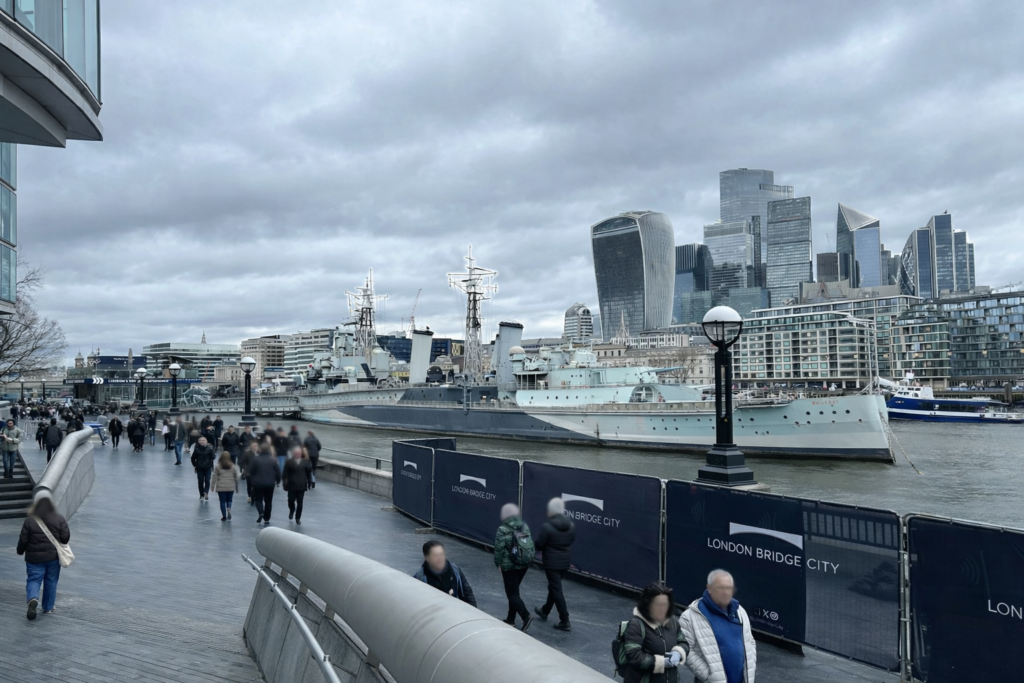
Beside Tower Bridge in London lies a warship that truly saw combat. She is not a replica, not a prop, but a steel vessel that emerged from the storms of the North Sea and the gunfire of the Korean War. HMS Belfast rests quietly on the Thames, yet the moment you step onto her deck, you realise this is no ordinary attraction, but a chapter of history you can physically enter.

Launched in 1938, this light cruiser took part in Arctic convoys, helped sink the German battleship Scharnhorst, and opened fire on the French coast during the D-Day landings in 1944. After the Second World War, she sailed to Asia and carried out bombardment missions during the Korean War. These are not just a few lines on an information board. They are gun turrets you can touch, a bridge and engine room you can see with your own eyes. Standing beside the great guns on the forward deck, looking out at the glass façades and skyline of modern London, you may suddenly sense that today’s prosperity and calm were once secured at the cost of steel and lives.

A recent news report has added a layer of warmth to this warship. The BBC told of a Hong Kong family who, while visiting the ship, unexpectedly found their grandfather’s name in the crew records, confirming that he had served on board during the Korean War. For that family, the visit was not merely an exhibition but a reunion with their own history. HMS Belfast is not only a symbol of Britain’s military past. It is also connected to Hong Kong, to the Far East, and to many Chinese who served under the structures of the Empire. As you walk through the narrow passageways below deck, you may find yourself thinking of your own elders and the stories they never fully told.

HMS Belfast is managed by the Imperial War Museums and forms part of its wider network. IWM members can enter free of charge. For non members, tickets cost about £26 for adults and around £13 for children aged five to fifteen, with free entry for those under five. Admission includes access to multiple decks and interactive exhibition areas. By London standards, it is a substantial and distinctive experience.

It is worth noting that this is a real warship converted into a museum. The corridors are narrow and the stairs steep. It may not be suitable for everyone, particularly those with limited mobility or sensitivity to enclosed spaces. Yet that very constraint makes the experience authentic. You are not reading history in a flat gallery space. You are moving through steel and rivets, sensing the living and fighting conditions of sailors decades ago. That level of immersion is rare in conventional museums.

London does not lack attractions. Yet places that invite quiet reflection are fewer than one might think. Next time you walk past Tower Bridge, consider setting aside half a day to come aboard. Stand on the deck with the river wind in your face, look at the city as it is today, and reflect on the gunfire and distant voyages that once shaped it. The visit may carry more weight than you expect.

⚓ Above the Guns, Within the Memory: Why HMS Belfast Is Worth Boarding in Person Read More »

Why Accurate Weather Forecasting Can Be Easy — and Completely Meaningless

When people talk about weather forecasts, the most common question is simple: is it accurate? If the only standard is avoiding missed events, the answer is surprisingly easy. Forecast rain every single day. You will never miss a rainy day. Your hit rate will reach 100%. It looks impressive. It means nothing.

In forecast verification, one of the most basic metrics is POD, the Probability of Detection. It is calculated as the number of correctly forecast events divided by the number of events that actually occurred. Suppose there are 100 rainy days in a year. As long as all 100 are forecast, the POD is 100%. If you predict rain every day, this condition is automatically satisfied. Even someone with no judgment at all can achieve a perfect score on paper.

But the problem appears immediately. On the remaining 265 days, it does not rain. Yet all of them are forecast as rain. These are false alarms. That is where FAR, the False Alarm Ratio, becomes relevant. FAR is calculated as the number of false alarms divided by the total number of forecast events. If rain is forecast every day, then out of 365 forecasts, only 100 are correct and 265 are false alarms. The FAR is about 73%. In other words, more than seven out of ten warnings are unnecessary. Trust quickly erodes under such conditions.

This is why POD alone is meaningless. A forecast can inflate its detection rate through extreme strategies while simultaneously amplifying false alarms. On the other hand, if rain is never forecast, the FAR is zero. Yet every rainy day is missed. The POD falls to zero. That is equally useless. The real challenge lies in finding a reasonable position between these extremes.

Meteorologists often use CSI, the Critical Success Index, to assess hits, false alarms and misses together. CSI is calculated as the number of hits divided by the sum of hits, false alarms and misses. If a forecast is too aggressive or too conservative, CSI will remain low. Only with balanced judgment does the index improve. This metric forces forecasters to take responsibility for overall performance rather than hide behind a single flattering number.

At its core, this is a question of risk management. If the cost of missing an event is extremely high, such as heavy rainfall triggering landslides, a higher false alarm rate may be acceptable. If the cost of false alarms is substantial, such as unnecessary school closures or economic disruption, then false alarms must be tightly controlled. Forecasting is never a simple competition about being right or wrong. It is a trade-off between costs and risks.

What is described above concerns basic categorical forecast verification. Modern weather forecasting increasingly uses probabilistic formats, such as predicting a 30% or 70% chance of rain. Verifying probabilistic forecasts involves deeper concepts such as reliability, resolution and the Brier Score. These are far more complex than POD or CSI. Determining whether a probabilistic forecast is both reliable and capable of distinguishing different outcomes is another layer of evaluation. That discussion will have to wait.

The idea of being 100% accurate is often little more than a definitional trick. Choose a metric that favours your strategy and impressive numbers will follow. Responsible forecasting requires multiple metrics and clear explanations of trade-offs. Numbers do not speak for themselves. People decide which numbers to emphasise.

What applies to weather forecasts applies equally to other forms of prediction. If we chase surface accuracy without confronting costs and uncertainty, any prediction can be made to look perfect. The question is not whether perfection is achievable. The question is whether we are willing to measure meaning honestly.

Why Accurate Weather Forecasting Can Be Easy — and Completely Meaningless Read More »

Sutton: A New Home for Hongkongers — What “Hong Kong Building” Reveals About Migration Choices

Within Hongkonger community forums and migration videos, several residential blocks near Sutton railway station are often informally nicknamed “Hong Kong Building”. The term is not an official name but a community label. It reflects the relatively high concentration of Hong Kong residents in those buildings, where Cantonese is frequently heard in lifts and familiar faces appear in corridors.

Sutton has become a preferred landing point for practical reasons. As one of London’s 32 boroughs, it sits close enough to central London while offering a slower suburban pace of life. There is more green space, a relatively safe residential environment and, compared with many inner London districts, more affordable rents and property prices. For families leaving Hong Kong’s dense urban landscape, this balance carries clear appeal. The Daily Mail previously reported that since the launch of the BN(O) visa in 2021, more than 4,000 Hongkongers have settled in Sutton, forming what some describe as a “Little Hong Kong” cluster.

Education is another decisive factor. Sutton hosts several state and grammar schools rated Outstanding by Ofsted, including the well-known Sutton Grammar School. For families planning long-term residence, access to strong schools is not a peripheral issue but a central one. School catchment areas shape housing decisions, and educational continuity offers reassurance in an unfamiliar country.

Transport connectivity also matters. Sutton station is served by Thameslink and other rail services, with direct trains to central London taking around 30 to 40 minutes. Many residents commute daily into the city. The advantage lies in being close to employment opportunities without living amid the intensity and cost of the inner zones. For working families, this balance between accessibility and quiet residential life weighs heavily in location choices.

For households that continue to travel between the UK and Hong Kong, proximity to Gatwick Airport adds a practical benefit. From Sutton, a southbound train or bus journey of roughly half an hour can reach the airport, avoiding the need to cross central London. For families making frequent long-haul trips, time efficiency becomes more than a convenience.

Community life has gradually expanded alongside the arrival of Hongkongers. Some estate agents offer Cantonese-language services. The high street includes chains such as Lidl and Starbucks, alongside a modest presence of Asian food options. Churches and community groups have organised bilingual welcome sessions to help newcomers navigate local systems and daily routines.

Yet Sutton is not without challenges. As demand rises, property prices and rents have edged upward. Some longer-term residents view demographic change with mixed feelings. When communities become heavily concentrated, questions of cultural integration inevitably follow. Genuine integration involves more than language acquisition or lifestyle adjustment. It requires building mutual recognition within a diverse society.

In this sense, the phrase “Hong Kong Building” captures a natural human instinct. In an unfamiliar city, migrants seek shared language, cultural familiarity and informal support networks. Sutton’s attraction lies not in a single block of flats, but in the broader combination of transport links, educational resources, relative affordability and perceived safety. How the area balances continued growth with cultural integration will shape its next chapter.

Sutton: A New Home for Hongkongers — What “Hong Kong Building” Reveals About Migration Choices Read More »

The Boundaries of Seasons: Comparing Calendars and Climate Indicators

nDiscussing winter without first clarifying the time systems can lead to confusion. The existence of the four seasons is due to the Earth’s axial tilt of approximately 23.5 degrees and its orbit around the Sun. When the Northern Hemisphere tilts away from the Sun, the shortest day occurs at the winter solstice, typically around December 21. This marks the start of the astronomical winter. Similarly, the vernal equinox, summer solstice, and autumnal equinox are defined by the Sun’s position on the ecliptic, representing physical facts.n

nFor convenience in statistics, meteorology divides seasons by whole months. In the Northern Hemisphere, winter is defined as DJF, or December (Dec), January (Jan), and February (Feb); spring as MAM; summer as JJA; and autumn as SON. These abbreviations are widely used in climate reports and academic research. When average winter temperatures are announced, they usually refer to data from the DJF period, not starting from the winter solstice. The aim is comparability.n

nThe lunar calendar is a lunisolar system, with many traditional Chinese festivals determined by lunar months and phases, such as the Spring Festival, Lantern Festival, Dragon Boat Festival, and Mid-Autumn Festival. Based on the synodic month, the lunar calendar uses intercalation to stay in sync with the solar year, preventing complete detachment from the seasons. However, the dates of these festivals in the Gregorian calendar can vary by several weeks each year. They do not consistently correspond to a specific solar altitude or daylight condition. Comparing climate change based on the warmth of a particular year’s Spring Festival is of limited significance, as its solar position varies.n

nHowever, the solar terms in the lunar calendar are calculated based on the Sun’s position on the ecliptic, with each term covering 15 degrees. As a result, solar terms like the Beginning of Spring and Beginning of Winter have relatively stable dates in the Gregorian calendar, usually differing by only one day. When discussing changes in daylight and seasonal transitions, solar terms better reflect the actual rhythm of the Sun’s movement, providing more meaningful reference.n

nThere are similar examples in the West. Although most festivals have fixed dates, Easter is set on the first Sunday after the first full moon following the vernal equinox, with dates ranging from late March to late April. While linked to the equinox, it does not occur under the same daylight conditions each year. Long-term temperature comparisons based on Easter can also lead to misconceptions.n

nThe issue is not with the festivals themselves, but with conflating different calendar systems. The solar calendar reflects the geometric relationship between the Earth and the Sun, while the lunar system reflects the Earth’s cycle with the Moon. Although solar terms are incorporated into the lunar calendar system, they are fundamentally calculated based on the Sun’s movement; lunar calendar festivals, however, often vary with the lunar phases. Their purposes differ. Using floating festivals as a climate benchmark makes it difficult to maintain rigor.n

nThe boundaries of the seasons are rooted in celestial mechanics. When discussing whether winters are becoming warmer, we should refer to the Sun’s position and DJF data, not festival memories. Distinguishing between institutional affiliations and astronomical principles is essential for understanding the seasons. Otherwise, we mistake cultural time for natural time.n

The Boundaries of Seasons: Comparing Calendars and Climate Indicators Read More »

Jaguar Land Rover: The Halo and Reality of a UK Carmaker

nJaguar Land Rover is the largest car manufacturer in the UK. Its ups and downs are not just the story of a single company but a microcosm of the realities facing British manufacturing.n

nThe company is currently owned by India’s Tata Motors, yet its research and brand core remain in the UK. Its two main brands, Jaguar and Land Rover, are taking distinct paths: Jaguar is preparing to transform into a fully electric luxury brand, while Land Rover relies on models like the Range Rover and Defender to sustain sales and profits.n

nAccording to the fiscal year data ending March 2025, JLR’s global production stood at 428,854 vehicles. Post-pandemic, the supply chain is gradually recovering, and production is rebounding, though it has not returned to peak levels. Over 80% of the vehicles are exported, with major markets including the US and China. This indicates a heavy reliance on global demand and trade conditions, meaning any fluctuations in external markets quickly impact the UK base.n

nThe UK remains JLR’s manufacturing heartland. Solihull is responsible for producing flagship models like the Range Rover and Defender; Halewood in Liverpool specializes in various SUVs; Wolverhampton hosts an engine manufacturing center; and Birmingham’s Castle Bromwich plant has shifted from full vehicle assembly to producing body components. These facilities directly employ over 30,000 people and support an extensive supply chain. For the West Midlands, JLR is nearly synonymous with industrial lifeblood.n

nA major cyberattack starting on August 31, 2025, abruptly constricted this lifeblood. The company was forced to shut down its internal IT systems, halting production at several UK plants for over five weeks. As a high-value-added industry, any production disruption rapidly affects parts suppliers and logistics chains. That quarter, UK industrial output significantly declined, with car manufacturing being a drag. Independent assessments estimated an overall economic loss of about £1.9 billion, marking it as one of the most economically damaging cyber incidents in UK history. The fact that a single company’s IT risk can escalate into a macroeconomic issue is itself a warning sign.n

nThe attack also highlighted another reality. Modern manufacturing is highly digitized, with production lines and information systems closely integrated. In the past, strikes and parts shortages affected output; today, it might be a piece of malicious code. As factories rely on real-time data and automated scheduling, cybersecurity is no longer a support function but a part of production capacity.n

nFuture challenges are even more complex. Electrification requires massive investment and a stable battery supply chain. The UK’s domestic battery capacity is still being developed. Global market competition is intensifying, with Chinese brands rapidly rising and US policy changes frequent. JLR must maintain its luxury brand premium while completing its technological transformation, a considerable pressure.n

nJaguar Land Rover remains the face of the UK automotive industry. But whether the facade is stable depends on the internal structure. When manufacturing, technology, and the national economy are closely linked, a production halt can sway GDP. Whether British manufacturing can maintain resilience amid electrification and digital risks is a question that extends beyond the carmaker itself.n

Jaguar Land Rover: The Halo and Reality of a UK Carmaker Read More »

Was Jesus Christ White? Bridging History and Belief

nIs Jesus Christ white? This question persists not merely out of curiosity about appearance, but because it applies modern racial concepts to an ancient figure.n

nHistorically, Jesus Christ was born in the 1st century Roman Empire’s province of Judea and grew up in Galilee. He was Jewish. The local population at the time belonged to the Near Eastern Semitic groups, typically with olive to brown skin, dark hair, and deep-set eyes. Archaeological and anthropological studies suggest his appearance would have been similar to modern-day Levantine men, rather than the fair-skinned, blonde-haired, blue-eyed image typical of Northern Europeans. The Gospels do not describe his specific features, only affirming his ethnicity and identity. By modern racial classifications, he was unlikely to resemble the typical European white image seen in Renaissance paintings.n

nWhy, then, is he often depicted as white in European churches and religious art? The reason lies in the shifts of historical power and cultural centers. After Christianity became the state religion of the Roman Empire in the 4th century, European artists dominated religious art. They modeled holy figures on people around them, naturally Europeanizing the image. As colonial expansion spread, this visual version was carried worldwide, gradually being mistaken for historical reality.n

nHowever, this is not the only depiction. In African iconography, he is shown with darker skin; in Asian church art, he has Eastern features; in Latin America, he resembles local ethnic characteristics. Religious imagery often localizes to help believers form emotional connections. Images are a cultural language, not historical photographs.n

nThe issue becomes sensitive due to modern racial politics. During colonial times, the image of a white Jesus was used to reinforce narratives of civilizational superiority. When religious figures are tied to a specific ethnicity, faith can be co-opted by power. Since the 20th century, scholars have emphasized his historical background as a Middle Eastern Jew, attempting to steer the discussion back to facts.n

nYet, according to biblical understanding, he is not just a historical figure but the Son of God, sent by God to the world. He came to bring salvation to all humanity. This identity and mission transcend ethnic and national boundaries. Historically, he was unlikely to be the white figure of modern imagination; from a faith perspective, skin color is not central. His physical form had a regional background, but his mission was universal. He was born into a specific ethnicity in history, yet transcends ethnicity in faith. The true question is not about his skin color, but whether we are willing to acknowledge that a value transcending ethnicity and borders is the reason this story has endured for two millennia.n

Was Jesus Christ White? Bridging History and Belief Read More »

Paul Chan’s Fiscal Strategy: A Nobel-Worthy Economic Innovation?

nHong Kong’s sudden wealth is an illusion. Over the past three fiscal years, deficits have been clearly recorded. In the 2022/23 fiscal year, the deficit was HKD 122.3 billion, followed by approximately HKD 100.2 billion in 2023/24, and still HKD 48.1 billion in 2024/25. Land revenues have declined, stamp duties have shrunk, yet recurrent expenditures continue to rise annually. This is not a cyclical fluctuation but a structural issue. Reserves are dwindling, and the gap is widening.n

nThen a miracle occurred. The books turned to show a surplus. The method was simple: classify debt issuance as income. Borrowed money was counted as earned money, and thus the deficit vanished. Suddenly, the fiscal health appeared robust. If economics could be this flexible, it would indeed be worthy of applause.n

nThe definition of a deficit is inherently straightforward. When expenditure exceeds income, the difference is the deficit. The amount of borrowing should match this shortfall. Borrowing is merely a tool to fill the gap. Now, the logic has been inverted. Previously, borrowing was necessary due to deficits; now, because money is borrowed, there is no deficit. This is not fiscal improvement; it is a rewriting of language. Using borrowing to negate the necessity of borrowing is a beautifully circular argument, yet utterly hollow.n

nProponents might argue that issuing bonds is normal financing, so why fuss over categorization? The issue is not with borrowing but with honesty. Financing involves advancing future resources, while income is the creation of resources in the present. If these are conflated, the deficit becomes a decorative term. The more borrowed today, the greater the apparent surplus. Such logic is not only safe but also aggressive.n

nLooking at the UK makes this clearer. In the 2025/26 fiscal year, the UK public sector net borrowing is about GBP 140 billion, with a daily budget deficit of approximately GBP 94.9 billion, accounting for about 4.6% of GDP. This indicates that expenditures far exceed tax revenues, necessitating market financing to fill the gap. If the UK adopted the same principle, treating this GBP 140 billion borrowing as income, the annual deficit would immediately approach zero. Fiscal discipline would not need reform, nor would economic structures require adjustment; only the classification would need rewriting. The deficit would no longer exist, only a definitional issue would remain.n

nThe brilliance of this approach lies in its self-contained logic. A deficit equals the need to borrow money, borrowing money equals increased income, and increased income equals no deficit. The logical loop is seamless. Outsiders see the numbers; insiders see the definitions. Change the definition, and reality complies.n

nIf this principle were widely applied, most countries with long-term deficits could transform overnight. The United States, Japan, the United Kingdom would no longer need to debate deficits. The more borrowed, the more surplus. The fiscal conundrum would be effortlessly resolved. This is indeed a breakthrough. It does not increase productivity or reduce spending but successfully eliminates the deficit. Economists have studied for decades and may not have conceived such a direct solution.n

nTherefore, if the Nobel Prize in Economics rewards innovative thinking, Paul Chan should be a contender. He has demonstrated a shortcut: by treating borrowed money as earned money, fiscal deficits become a thing of the past. Whether the debt remains, interest accumulates, or repayment is inevitable, those are problems for tomorrow. Today, the books have already triumphed.n

Paul Chan’s Fiscal Strategy: A Nobel-Worthy Economic Innovation? Read More »

Hong Kong: A City of Migration and Generational Movement

nHong Kong has never been a static place. Its history is essentially a history of migration. To discuss immigration today by only focusing on recent departures would be incomplete. The roots of Hong Kong’s people are inherently tied to movement.n

nIn the early 19th century, as the port opened, a large number of residents from coastal Guangdong moved south in search of livelihoods. The turmoil of the late Qing Dynasty, including the Taiping Rebellion, wars, and famines, pushed even more people to this small port. Around 1949, a new wave of population influx occurred. Political upheaval and social restructuring led hundreds of thousands to cross the border and rebuild their lives under British rule. During the 1950s and 1960s, Shanghai businessmen and skilled workers migrated south, bringing capital and knowledge that took root. Hong Kong’s industrialization and export economy were co-created by these immigrants and local labor.n

nIn other words, Hong Kongers are essentially descendants of mainland immigrants. The city’s character is built on escaping hardship, seeking livelihoods, and entrepreneurship. Its vitality stems from a do-or-die mentality.n

nBut the story does not end there. After the 1984 Sino-British Joint Declaration, uncertainty spread. From the mid-1980s to before 1997, a large wave of emigration occurred. Canada, Australia, and the UK became primary destinations. Many obtained residency rights and adopted a “astronaut” lifestyle, shuttling between countries. Families were separated, and assets were allocated in both places, serving both as a hedge and a pathway for their children.n

nAfter 1997, a phenomenon of return migration emerged. With economic improvement and increased opportunities, some immigrant families chose to return to Hong Kong. However, the social unrest of 2019, coupled with the implementation of the National Security Law in 2020, triggered a new wave of emigration. The UK introduced the BN(O) visa scheme, with over 180,000 applications by 2025. Canada and Australia also relaxed related arrangements. Mobility has once again become a key theme.n

nIt is noteworthy that Hong Kong people are both immigrants and receivers. During the era of Vietnamese boat people, Hong Kong bore humanitarian pressure. After the 1990s, mainland professionals and students moved south, becoming new blood for the city. In recent years, Southeast Asian and South Asian communities have settled here. Hong Kong’s social structure has always been layered and overlapping.n

nSome say emigration is an escape, others call it betrayal. But looking back over a century, migration is actually a strategy. When circumstances change, people seek new paths. This is neither a moral judgment nor an emotional outburst, but a pragmatic choice. Risk diversification, opportunity comparison, and institutional considerations form the core of decision-making.n

nThe real question is not who leaves, but why generation after generation must constantly weigh the decision to stay or go. When a city’s allure coexists with uncertainty, mobility becomes the norm. Hong Kong’s fate is always linked to both sides of the border.n

nWe are all descendants of immigrants and may be the starting point for the next migration. The city may not empty, but the quality and quantity of its population will change. The issue is not whether to emigrate, but how those who remain will reshape the future of this city.n

Hong Kong: A City of Migration and Generational Movement Read More »

Traffic Jams at Roadworks: Engineering Flaw or Cultural Choice?

nRoad construction is fundamentally a technical issue, yet it often evolves into a cultural phenomenon. When two lanes narrow into one, a single-file queue frequently forms hundreds of meters in advance, leaving the other lane empty. This isn’t due to regulations but because people don’t want to be seen as rude.n

nIn British driving culture, queuing is almost synonymous with fairness. The unspoken rule is first come, first served. When drivers see a lane closure sign ahead, they typically choose the lane that still appears ‘normal’ and queue up. The other lane, even if still open, gradually becomes unused. This isn’t because it’s off-limits, but because using it would be perceived as cutting in line.n

nThis psychological force is not to be underestimated. Even though the Highway Code permits using both lanes and merging alternately at the narrowing point, most people prefer to merge early into the so-called main lane. Some even deliberately position their vehicles to block others from using the empty lane. For them, this isn’t obstructing traffic but maintaining order. The problem is that when everyone compresses into a single lane early, the queue lengthens rapidly.n

nThis early queuing effect is particularly evident during motorway works, such as on the M25 or M6. The bottleneck may only be at the narrowing point of a few dozen meters, yet the tailback can extend for several kilometers. If the upstream section is near an interchange or ramp, even vehicles not intending to pass through the construction site are slowed down. The single-lane mentality amplifies into a broader network efficiency issue.n

nIf the root of the problem lies in cultural intuition, mere publicity may not suffice. Instead of asking drivers to change their mindset, it might be more effective to adjust engineering designs so that the space itself guides behavior. The current common practice is to completely close one lane while keeping the other intact, visually creating a primary-secondary distinction. Drivers can easily identify which is the ‘real’ lane and which is a temporary extension.n

nPerhaps the approach could be reversed. Engineers could refrain from fully closing one lane and instead gradually reduce the width of both lanes as they approach the narrowing point, each retaining half its width. Both lanes would narrow simultaneously and remain usable until merging at the final point. This way, there is no obvious main lane. If drivers abandon one lane early, it would seem irrational. The spatial layout itself would diminish moral anxiety.n

nThis half-width closure design delays the compression action to the actual bottleneck location. The earlier sections maintain dual-lane flow, leading to a more balanced traffic distribution and naturally shortening the tailback. Even if drivers still value fairness, they would only need to alternate at the last few dozen meters, rather than making a moral statement hundreds of meters earlier.n

nRoadworks are not just about laying asphalt and placing cones; they also shape behavior. British drivers value politeness, which is a virtue. However, if politeness translates into excessively early single-lane queuing, a systemic response is required. Instead of blaming drivers for being too rule-abiding, we should ask whether the design offers a more reasonable choice.n

nRoadworks will eventually be completed, but culture endures. Next time you see an empty lane, perhaps it’s not necessary to rush to judge who is being impolite, but rather to consider whether the space has already predetermined the answer.n

Traffic Jams at Roadworks: Engineering Flaw or Cultural Choice? Read More »

When Extraterrestrial Forces Rewrite Human Destiny

nThe true end of civilization may not come from war, but from celestial visitors. Approximately 66 million years ago, an asteroid with a diameter of about 10 to 15 kilometers struck what is now the Yucatán Peninsula in Mexico, leaving behind the Chicxulub crater. The energy released by this impact far exceeded the combined power of all human nuclear weapons. The subsequent global cooling and ecological collapse led to the extinction of about 75% of species, marking the end of the dinosaurs. This is not mythology, but a fact confirmed by geological and chemical evidence.n

nIf an impact of similar magnitude were to occur today, humanity would not vanish instantly, but civilization would face unprecedented disruption. The immediate impact would depend on the location. An impact on land near densely populated areas could cause shockwaves, extreme heat, and massive fires, killing tens of millions or even hundreds of millions within hours. If it struck the deep sea, coastal regions might be hit by colossal tsunamis. Regardless of the impact site, the true determinant of human fate would not be the first day, but the ensuing years.n

nThe scientific community has conducted extensive simulations on the so-called ‘impact winter.’ Dust and sulfuric aerosols would enter the stratosphere, blocking sunlight, causing surface temperatures to plummet, and severely weakening photosynthesis. Modern society heavily relies on stable agriculture and global supply chains. If major grain-producing regions suffered consecutive years of reduced yields, global food reserves would quickly deplete, and energy and transportation systems would be disrupted, turning food into a matter of survival rather than just a pricing issue. With today’s population of approximately 8 billion, in extreme scenarios, the death toll could likely reach billions, not just millions or tens of millions.n

nThere is no precise academic figure, as too many variables exist. The impact location, season, angle of entry, and level of international cooperation would all alter the outcome. However, climate models and ecological inferences suggest this would be a near-global systemic collapse. Some populations might survive in underground facilities, remote areas, or countries with high reserves, but it would be a world with drastically reduced populations and regressed technological levels.n

nIt is important to emphasize that such impacts are extremely low-probability events. The frequency of a 10-kilometer-diameter asteroid striking Earth is about once every tens of millions to hundreds of millions of years. Humanity has not existed long enough to naturally encounter one. However, low probability is not zero probability. NASA and the European Space Agency have been monitoring near-Earth objects and have successfully tested asteroid deflection technologies in recent years. These efforts may not change the randomness of the cosmos, but they at least show that humanity is beginning to proactively respond.n

nDiscussing such disasters can easily lead to doomsday sentiments. What truly merits reflection is the resilience of civilization. When food, energy, and order are simultaneously under pressure, can society still maintain cooperation and rationality? When the dinosaurs went extinct, there was no civilization to collapse. If a similar-scale event were to occur today, humanity would face not only an astrophysical problem but a test of institutional and coordination capabilities.n

nThe sky does not target humanity, but it will not show mercy either. If a Chicxulub-level impact were to recur, deaths could reach billions, and survivors would face a prolonged winter. The future of civilization depends not only on celestial orbits but also on whether we are willing to remain vigilant and prepared for the enormous risks of extremely low probability.n

When Extraterrestrial Forces Rewrite Human Destiny Read More »

Scroll to Top