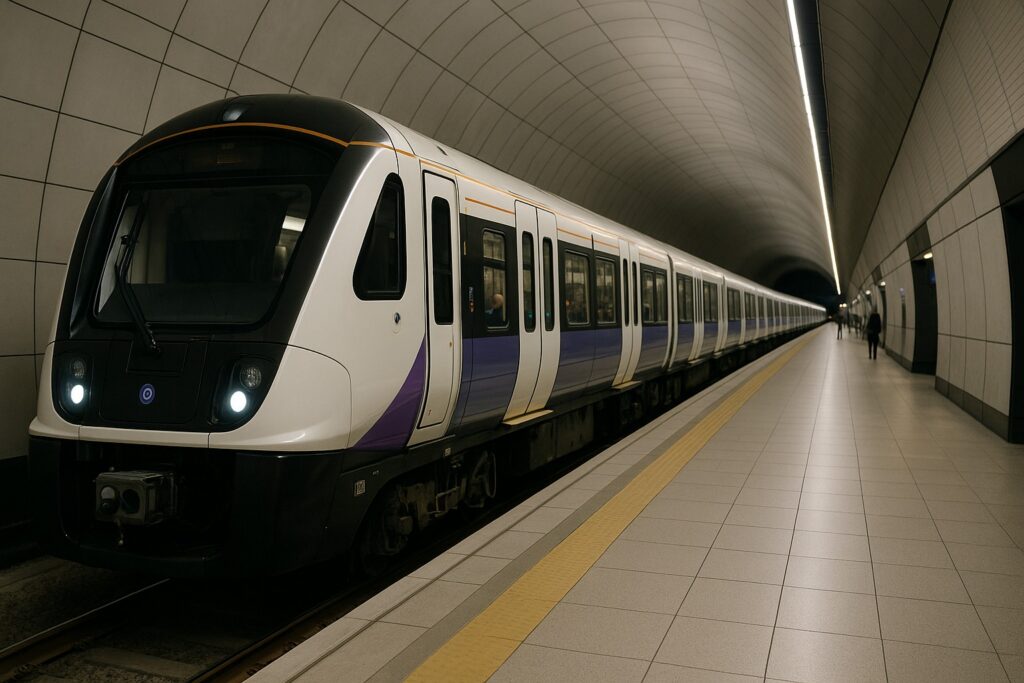
The Elizabeth Line, formerly known as Crossrail 1, has delivered an undeniable performance for London. Since its opening, it has quickly become one of the busiest and most reliable railways in the UK. More importantly, it has fundamentally altered the perception of distance within the city. Areas such as Reading, Slough, and Abbey Wood, once considered ‘too far to live,’ are now naturally included within the daily commuting range. The recruitment radius for businesses has expanded, residents’ daily rhythms have become more predictable, and London has re-learned how to grow outward. Crossrail 1 demonstrates that the value of intercity rail lies not in speed, but in frequency, reliability, and direct access.
The concept of Crossrail 2 aims to replicate this model. Its origins can be traced back to the 1970s, with a consistent goal: to provide London with a high-capacity north-south backbone to alleviate the long-standing overload on the Victoria and Northern lines. By the 2010s, the route had gradually taken shape. The core section runs through the city centre from Wimbledon via Clapham Junction, Victoria, Tottenham Court Road, and Euston St Pancras; at both ends, branches extend outward. The southwestern terminus includes four major endpoints: Shepperton, Hampton Court, Chessington South, and Epsom; the northeastern end extends to New Southgate and Broxbourne, with potential connections to Hackney Central to the east. The overall design is clear: a high-density main line traversing the city, with multiple branches converging on the outskirts.
This route configuration precisely covers the actual residences of recent Hong Kong migrants. These migrants are concentrated in southwest London, including towns like Kingston upon Thames, New Malden, and Wimbledon. These areas are stable in terms of schools, mature in terms of community, and offer larger living spaces, making them natural choices for family-oriented migrants. However, the transportation reality is also apparent: travel into the city primarily relies on National Rail, which has infrequent services, limited options during peak hours, and delays that can disrupt the entire journey.
The key significance of Crossrail 2 for these communities lies in its ‘mainlining.’ The core section will operate at a frequency close to that of the Underground, with services every few minutes during peak times. For residents along the line, commuting into the city will no longer require checking timetables or enduring the risks of delays and disruptions across the entire network.
As rail services become more frequent, the definition of ‘distance’ is naturally rewritten. Living in southwest London no longer equates to sacrificing urban opportunities, but rather choosing an alternative lifestyle. For dual-income families, there is greater time flexibility; for those needing to frequently travel to the city centre, their employment and development radius is effectively widened.
Overall, this represents the healthiest development path for London. Crossrail 1 connects east to west, while Crossrail 2 fills in the north-south gap, completing the urban framework. For Hongkongers, it offers not speculative dreams, but a tangible prospect of living comfortably without being marginalized. As distance is recalculated, the reasons to stay become more compelling.