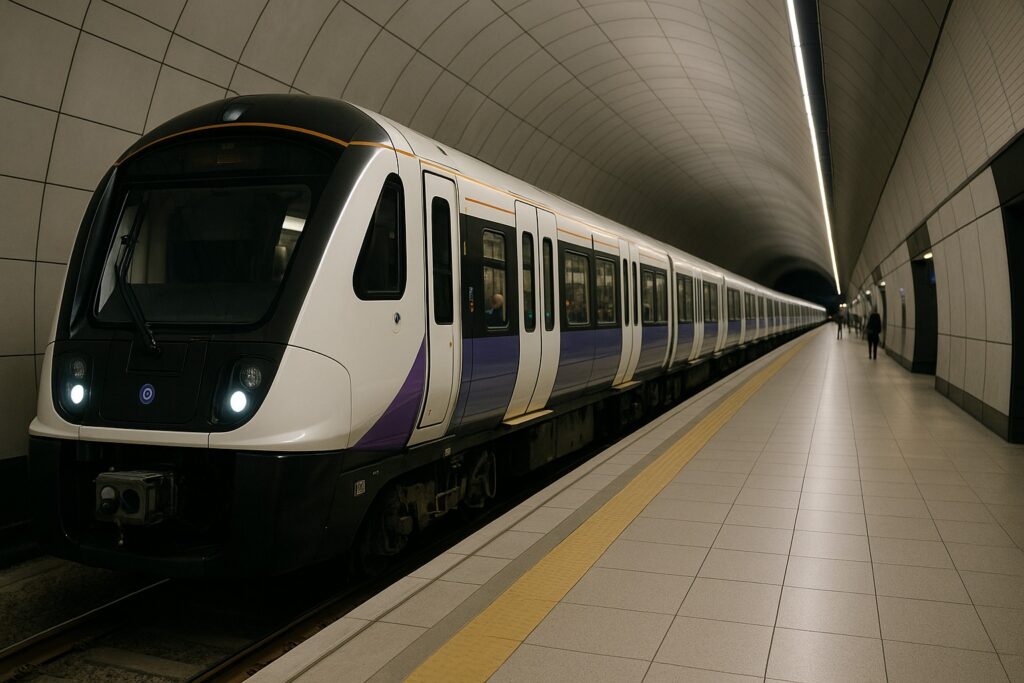
Today, the Elizabeth line takes passengers from London Paddington to Canary Wharf in around 17 minutes, roughly half the journey time before it opened. Spacious, air-conditioned trains and bright stations offer a striking contrast with the ageing Tube services familiar to many Londoners. Within just a few years, this purple railway has become so deeply embedded in city life that it feels as though it has always been there. Yet before and during construction, it was associated with enormous costs, delays and management failures. There were even discussions about cutting stations and branches. Today, the harder question is how London would function without it.
The project was called Crossrail, and its central idea was to connect the railways east and west of London through new tunnels beneath the city centre. Stretching over 100 kilometres, the Elizabeth line serves 41 stations, reaching Reading and Heathrow Airport in the west, and Shenfield and Abbey Wood in the east. It passes through Paddington, the West End and the City, while also serving Canary Wharf, running through London’s economic core. Previously, suburban passengers often reached a terminus on the edge of central London, then squeezed onto the Tube. Through trains now join those fragmented journeys together.
In 2010, Crossrail faced a government spending review, and discussions about savings reached into the heart of London. Reported options included cancelling either Bond Street or Tottenham Court Road station, and cutting the branches towards Maidenhead or Abbey Wood. Retailers and property owners around Bond Street signed a letter demanding that their station go ahead. Today, it is difficult to imagine a railway crossing London while bypassing such important West End destinations and interchanges. The tunnels would still be dug and trains would still pass through, but passengers would lose direct access. Saving the cost of a station could weaken the very reasons for building the railway.
Woolwich had already been excluded from an earlier version of the scheme. Parliamentary records from 2007 describe how the government had decided, around 2 years earlier, to omit the station to save money. It was restored after campaigning by local government, businesses and residents, with a developer taking part in building the station structure. This exposes a problem in infrastructure decisions. A station’s construction cost sits within the project budget, while the benefits of higher land values, employment and regeneration appear elsewhere. Counting only the money saved by omitting a station can overlook decades of lost opportunities for the surrounding community.
Subsequent delays and cost overruns deepened public doubts. The central section was supposed to open in December 2018. It finally welcomed passengers on 24 May 2022, roughly 3 and a half years late. On the comparable basis published by the government in 2022, forecast construction costs had risen from the £14.8 billion budget set in 2010 to £18.9 billion, a nominal increase of around 28 per cent, excluding trains and depots. The National Audit Office identified an overly compressed schedule, the absence of a realistic overall plan and excessive optimism that obscured problems. These failures cost taxpayers more and denied passengers the promised service for years.
Once the railway opened, passengers delivered their verdict through their journeys. The Elizabeth line has become the UK’s busiest single railway service. According to the Office of Rail and Road, it recorded around 257.4 million passenger journeys between April 2025 and March 2026, accounting for 14.1 per cent of the approximately 1.83 billion journeys on Great Britain’s rail network. Within these statistics, which exclude London Underground, roughly 1 in every 7 rail journeys used the Elizabeth line. For a route serving London and its surrounding areas, that is an extraordinary share of national rail travel. It has become a backbone of everyday transport.
The improvements begin as passengers enter the stations. The space, lighting, signs and platform design at the new central stations feel markedly more modern than many cramped and winding older Tube stations. Trains around 200 metres long have walk-through carriages, allowing passengers to move along the train, with dedicated wheelchair spaces and flexible areas for luggage and other needs. Every station offers step-free access from street to platform, while the new central stations also provide level boarding. For people travelling with pushchairs, suitcases or limited mobility, these features determine how manageable a journey is. They also allow more people to use the railway independently.
Air conditioning is another improvement passengers can appreciate every day. Elizabeth line trains have had it from the start, making a particularly noticeable difference in summer compared with the heat on some older deep-level Tube services. Mobile coverage across the entire line, including the central tunnels, was completed in 2024. Passengers can stay in touch, check connections and get things done underground. The burden of travel includes time spent standing in uncomfortable heat, navigating interchanges and losing contact along the way. A railway that reduces these frustrations can attract passengers in ways that a timetable alone cannot fully explain.
The time savings are equally tangible. In comparisons published by Great Western Railway before opening, the journey from Paddington to Tottenham Court Road fell from 14 minutes to 5. Liverpool Street went from 25 minutes to 11, while Abbey Wood fell from 61 minutes to 29. Passengers arriving from western England also gained better onward connections from Paddington into central and east London. Destinations that previously required awkward changes became much easier to reach. Over time, this changes where people are willing to work, shop and meet friends. The city’s geography may stay the same, but the practical distances within everyday life are rearranged.
These results far exceeded the post-pandemic planning forecasts. In 2022, Transport for London estimated that the Elizabeth line would carry between 130 million and 170 million passenger journeys a year by 2026. Its actual total for 2025/26 reached around 242 million, more than 40 per cent above the upper end of that range. Remote working changed commuting habits, yet a fast, comfortable railway still attracted enormous demand. People also travel to shop, visit family, enjoy entertainment and reach the airport. Reducing the time and effort involved unlocks demand previously held back by inconvenience, while diverting passengers from older routes frees up space across the network.
Changes in development are also becoming visible. In November 2025, the government cited evaluation findings showing that employment around Elizabeth line stations grew by 25 per cent between 2015 and 2023, compared with 14 per cent across London. Around 71,000 new homes had also been delivered near the stations since 2015. The railway works alongside land availability, planning and market conditions, providing an important foundation for development. Better connections make more places suitable for housing and business, while bringing previously distant jobs within reach. Housing and public services must keep pace if those transport improvements are to translate into broader improvements in people’s lives.
The Elizabeth line has become one of Britain’s most successful modern railway investments. London without it is now difficult to imagine. Its history also exposes the blind spot of Treasury-led government: excessive attention to short-term fiscal costs at the expense of transport, productivity and the wider development of cities. Construction spending appears immediately in the accounts. The time and opportunities lost through cancellation are borne by the public over decades. Britain still has many infrastructure projects worth funding. Unfortunately, before their future beneficiaries can make themselves heard, those projects can become convenient scapegoats for short-sighted politicians seeking spending cuts. How should Britain change the way it makes these decisions? Share your thoughts in the comments.