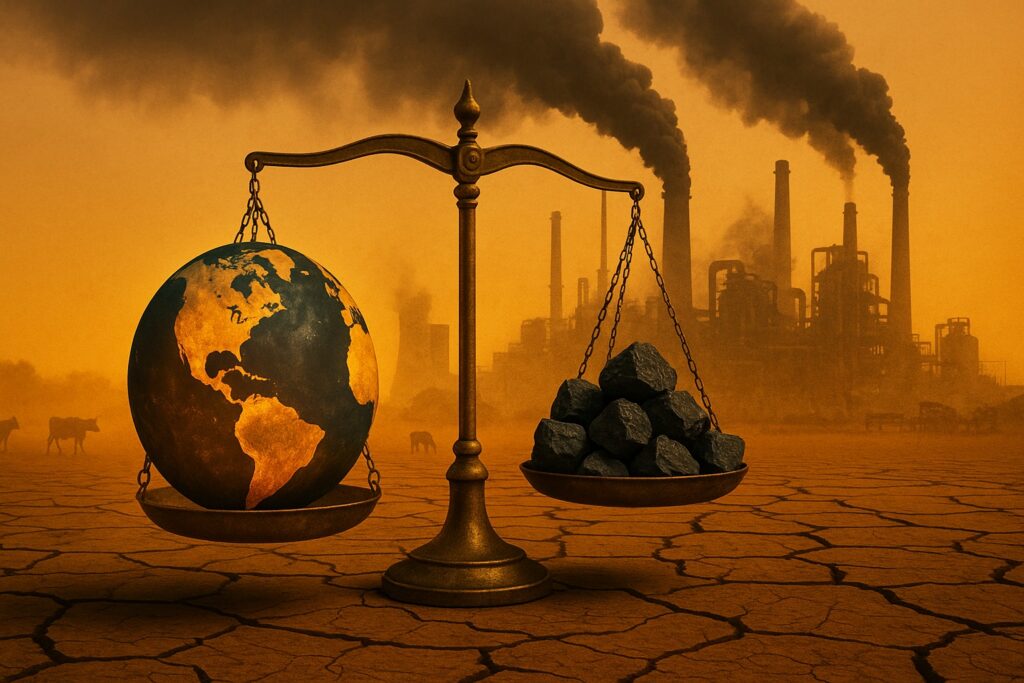
Looking back at modern history reveals an uncomfortable yet undeniable truth: most wars have, at their core, been about the plunder or control of fossil fuels. The slogans may vary and the justifications may be grand, but energy is almost never absent from the equation. Oil and gas are not merely commodities; they are integral to national power, diplomacy, and military strategy. Those who control production sites and supply lines hold the negotiating leverage and can even turn energy into a weapon.
A prime example of this is the expansion of the Japanese military during World War II. Japan, lacking domestic oil supplies, found its military machine nearly immobilized after the United States and Britain imposed an oil embargo. The strategic necessity of advancing into Southeast Asia to seize the oil fields of the Dutch East Indies became apparent. The attack on Pearl Harbor was not an isolated incident but a fierce response to being choked off from energy supplies. From the outset, the Pacific War was deeply marked by the shadow of oil.
The post-war history did not fundamentally change this dynamic. The Gulf War of 1991 was ostensibly about sovereignty disputes, but what truly concerned the West was the oil supply from the Persian Gulf. By the time of the Iraq War in 2003, the official narrative shifted from weapons of mass destruction to counter-terrorism, yet the fate of oil fields and energy contracts post-war made everything clear. More recently, the Russia-Ukraine war has seen the battlefield in Ukraine, yet energy shocks have reverberated throughout Europe, with gas pipelines, supply rights, and prices becoming crucial elements of strategic contention.
The common thread in these conflicts is not ethnicity or ideology but the high concentration, irreplaceability, and plunderability of fossil fuels. The distribution of underground resources is extremely uneven; some regions have them while most do not, creating a naturally one-sided and fragile dependency. Once supply is cut off, economies and societies are immediately impacted, making war an extreme yet realistic option.
Renewable energy disrupts this logic. A frequently underestimated yet critical fact is that under renewable energy conditions, the vast majority of countries in the world can actually meet their energy needs domestically. The geographical distribution of sunlight and wind is far more equitable than that of oil and gas. Only a few small, densely populated city-states or micro-island nations struggle to achieve high energy self-sufficiency. They are exceptions rather than the norm.
However, this does not imply that countries will become isolated energy islands. On the contrary, clean energy fosters multi-directional interdependence rather than new forms of dependency. Different regions experience varying sunlight, wind patterns, and seasonal peaks, allowing countries to support each other through cross-border power grids, regional dispatching, and energy storage systems. This creates a relationship that is equal and networked, unlike the control structures of the fossil fuel era where some have and others do not.
Such interdependence inherently reduces the incentives for war. You can blockade oil ports or bomb pipelines, but you cannot block sunlight and wind; you can occupy oil fields, but you cannot occupy an entire sky. Energy transitions from being a plunderable prize back to a decentralized public infrastructure, naturally diminishing the role of military power within it.
The stability of energy prices should not be underestimated either. Fossil fuel prices are extremely sensitive to wars, sanctions, and coups; energy inflation often first impacts livelihoods, then destabilizes regimes, and ultimately spills over into external conflicts. Renewable energy requires high upfront investment, but once established, its marginal costs approach zero, leading to stable price trends. Stable energy means stable social expectations, which translates to fewer political risks.
When the world no longer fights over the plunder of fossil fuels, wars will naturally lose one of their most common and realistic justifications. A clean energy world may not be perfect, but it is indeed a world closer to peace.