Energy

UK energy markets, the net-zero transition, and the politics of climate. Coverage of CfD auctions, the North Sea, fossil-fuel subsidies, heat pumps, electricity pricing, and how Britain’s energy choices ripple into household bills and industrial strategy.

Uruguay's Path to 98% Renewable Electricity: Not a Miracle, But Institutional Design

Uruguay’s Path to 98% Renewable Electricity: Not a Miracle, But Institutional Design

In 2008, Uruguay did not have a single wind turbine, nor a single solar panel. It powered a fast-growing economy — expanding by 5 to 7 per cent a year — on imported oil and a handful of ageing hydroelectric dams. When droughts struck, hydro output halved; when oil prices spiked, the entire country paid the bill. A decade and a half later, this South American nation of 3.5 million people now draws 98 per cent of its electricity from renewable sources. Generation costs have been roughly halved, and around 50,000 jobs have come with the transition. Over the same period, Britain reached its first full year without coal power in 2025, with renewables now supplying more than half of electricity generation. Hong Kong, by contrast, is still in the early stages of replacing coal with natural gas, and is not aiming for net-zero electricity until 2050. The gap between these three trajectories points to one uncomfortable conclusion. Uruguay’s achievement is often described as a green miracle. It was not a miracle. It was an institutional design.

The architect of the transition was a physicist, Ramón Méndez Galain, who served as Uruguay’s National Director of Energy from 2008 to 2015. His diagnosis cut against the conventional grain. A fossil-fuel system runs on a simple logic — buy fuel, sell electricity. Renewable energy has almost no fuel costs; nearly all the spending is upfront capital. The decisive question is therefore not the generation technology itself, but how to reduce the risk that this capital faces. A short-term spot market cannot do that; only a long-term capacity market can. Uruguay accordingly legislated to authorise its state utility, UTE, to run open auctions in which winning developers were guaranteed 20-year fixed-price power purchase contracts. Once prices stabilised, capital arrived. Within a decade, more than 700 wind turbines had been installed and roughly six billion US dollars had been invested.

The cleverest design choice was to substitute combination for storage. Uruguay runs hydropower, wind, biomass and solar in parallel — in 2024, hydro still supplied around 40 per cent and wind close to 30 per cent, with the proportions shifting year to year as rainfall varies. When droughts cut hydro, wind picks up the slack; when winds slacken, the reservoirs cover. The hydro reservoirs themselves act as enormous natural batteries, while interconnectors with Argentina and Brazil provide a flexible regional buffer for surplus and shortfall alike. The system therefore did not need expensive electrochemical storage. When low rainfall and weak winds coincide — as during the severe La Niña drought of 2022 to 2023 — a small amount of natural gas generation and cross-border imports steps in. That residual one to two per cent of fossil fuel is the safety valve at the heart of the design. Notably, Uruguay only began connecting its first large-scale battery storage systems to the grid in 2026, primarily to support the next phase of green hydrogen exports and full zero-carbon supply. The 98 per cent achievement of the past decade was reached without a single grid-scale battery.

What truly held the system together was political architecture, not engineering. Méndez bound every political party, trade union, business association and civil society group into a single energy policy. Parliament passed cross-party resolutions that wrote the long-term targets into national policy. Several governments have come and gone since — across the political spectrum — without disturbing the basic trajectory. The reason is not shared ideology. It is that every actor was tied into the same set of contracts: UTE’s auction commitments, 20-year power purchase agreements, cross-border grid arrangements. Unwinding any of them would mean dismantling the country’s commercial credibility along with them. No incoming government has been willing to pay that price.

The Uruguayan model is not without cost or constraint. Its existing large hydroelectric plants are mid-twentieth-century inheritances; building dams of comparable scale today would not survive contemporary environmental and indigenous-rights review. Its biomass capacity depends on by-products from local sugar and timber industries that other countries cannot easily replicate. What is genuinely exportable is therefore not the technical recipe, but three institutional principles: write long-term contracts into law, embed cross-sector consensus into policy, and design the system to minimise risk for private capital.

Britain’s problem is almost the inverse. The technology is plentiful — its wind resources are world-class, and on one half-hour in April 2025 the grid even ran 97.7 per cent zero-carbon. Long-term contract mechanisms exist as well, in the form of Contracts for Difference, which guarantee renewable generators a fixed strike price for fifteen years. But the wholesale market still sets its marginal electricity price by gas, so even when renewables exceed half of generation, household bills continue to track international fuel markets. Nuclear plants are ageing without replacement, storage and grid infrastructure lags behind generation growth, and successive governments have tightened and loosened commitments to the 2030 clean power target. What Uruguay completed in a decade, Britain has been working on for over twenty years and has yet to finish. The shortfall is not in the turbines. It is in the continuity of policy and the structure of the market.

Hong Kong’s predicament is different again. With limited land, dense population, no large-scale hydropower and modest wind and solar potential, the government’s own estimate is that local renewable generation can reach only 3 to 4 per cent by 2030. The remainder of the path must come from gas displacing coal, expanded nuclear imports from Daya Bay and other mainland plants, and possibly hydrogen and regional grid integration after 2035. This is essentially a substitution problem between fossil fuels and nuclear power, not a renewable expansion problem. But the institutional lessons from Uruguay still apply. The core question is not technical feasibility — it is whether a credible, legally binding long-term commitment exists. If Hong Kong could reach a cross-border renewable supply agreement with the mainland that sets out the decarbonisation timetable and capacity quotas for 2035 and 2050 in clear terms, the investment plans of the two local power companies, the cross-border transmission infrastructure and the trajectory of consumer tariffs could finally move out of year-by-year ambiguity and onto a predictable decarbonisation pathway.

Energy transition is most often misread as an engineering battle. Uruguay’s story shows it is closer to a contracts battle — over how governments commit, how markets allocate risk, and how political factions agree. A nation of 3.5 million has done what a wealthy Britain has dragged out for two decades and what a constrained Hong Kong has been forced to navigate around. The difference is not money, and it is not technology. It is whether anyone is willing to rewrite the rules thoroughly enough that even the next government cannot unwind them.

Uruguay’s Path to 98% Renewable Electricity: Not a Miracle, But Institutional Design Read More »

Nuclear Cargo Ships: The Technology Is Ready. The World Is Not.

Nuclear Cargo Ships: The Technology Is Ready. The World Is Not.

International shipping produces roughly one billion tonnes of carbon dioxide each year, accounting for nearly three percent of global greenhouse gas emissions. The International Maritime Organization has set a target of net zero by 2050. Yet the deep-sea cargo vessels that carry the bulk of world trade are among the hardest transport systems to decarbonise. Batteries lack the energy density for transoceanic voyages. Hydrogen bunkering infrastructure barely exists. Liquefied natural gas buys time but does not solve the problem. Into this gap, an idea from the mid-twentieth century has returned: nuclear propulsion.

Nuclear power at sea is not a new concept. Russia has operated nuclear-powered icebreakers on Arctic routes for decades. The United States Navy has run nuclear-powered carriers and submarines safely for longer still. The real question has never been whether the technology works. It is whether a commercial shipping fleet can be built around it. When the United States launched the NS Savannah in 1959, followed by Germany’s Otto Hahn and Japan’s Mutsu, all three vessels ultimately retired early — not because their reactors failed, but because ports refused to accept them and operating costs could not be justified commercially. A ship that functions and a shipping system that works are two entirely different things.

The current wave of interest is driven by the maturation of small modular reactor technology. SMRs are compact, factory-manufactured, and designed with greater inherent safety than conventional reactors, making them far more practical for integration into a ship’s engine room. China’s state-owned Jiangnan Shipyard has announced plans for a 25,000-TEU nuclear container vessel powered by a thorium molten-salt reactor — which, if built, would be the first of its kind in commercial history. HD Hyundai in South Korea is collaborating with classification society ABS on a conceptual design for a 16,000-TEU vessel driven by a 100-megawatt SMR. Research by Lloyd’s Register and Seaspan estimated that nuclear-powered containerships could eliminate bunker costs entirely and outperform both conventional and green-fuelled competitors over a vessel’s full operating life.

The obstacle is structural rather than technical. Putting a nuclear-powered merchant ship into service requires far more than a working reactor. Ports need to install specialist facilities and overhaul security protocols. Insurers need a functioning nuclear liability framework. Regulators across multiple jurisdictions need to agree on who approves a vessel flagged in one country and calling at ports in several others. In June 2025, the IMO’s Maritime Safety Committee approved amendments to the SOLAS Convention that for the first time open the door to SMR applications in commercial shipping. That is a step forward, but it remains the beginning of a process rather than a completed framework. No country or international body has yet produced a comprehensive licensing regime for nuclear-propelled merchant vessels.

This is a classic coordination failure. Shipping companies will not order nuclear vessels because no ports will accept them. Ports will not invest in receiving facilities because no nuclear ships are coming. Insurers will not develop products because there is no operating risk data. Regulators will not legislate because there are no applications to process. Every party is waiting for someone else to move first.

There is also an unexpected competitor. The artificial intelligence boom has generated enormous demand for land-based electricity, and the world’s largest technology companies are committing tens of billions of dollars to secure SMR capacity for data centres. The maritime industry cannot match that scale of capital mobilisation, and risks being crowded out of the supply chain for the very technology it needs.

Decarbonising shipping has no single solution. Green methanol, liquid ammonia, and battery power each find a role on shorter or specialised routes. But for the transoceanic trade lanes that carry the majority of global commerce, nothing else approaches nuclear fuel in terms of energy density. The promise of nuclear propulsion is genuine: zero carbon at sea, years of operation without refuelling, and more cargo space freed from the constraints of fuel storage. The distance between that promise and commercial reality, however, is filled by an entire ecosystem of infrastructure, regulation, and public acceptance that does not yet exist. The technology has arrived. The world is not ready for it.

Nuclear Cargo Ships: The Technology Is Ready. The World Is Not. Read More »

UK Electricity Is the Cheapest in Europe — If You Know How to Use It

UK Electricity Is the Cheapest in Europe — If You Know How to Use It

When people talk about British electricity bills, the conversation usually goes one way: expensive. The Ofgem price cap sits at nearly 25p per kilowatt-hour, higher than Hong Kong, France and Spain. That figure is accurate, but using it to compare electricity costs across countries is a fundamental misreading of how the UK energy market works.

Britain’s electricity market has been fully liberalised since the 1990s and is among the most open retail energy markets in the world. Households are free to choose their supplier and tariff — the Ofgem price cap exists solely to protect consumers who never actively shop around, not to represent the best available option. Treating the cap as a proxy for “UK electricity prices” is like using the most expensive item on a supermarket shelf to represent what people actually pay for groceries.

Households who understand the market pay 5.5p per kilowatt-hour for overnight electricity between 23:30 and 5:30 — the confirmed rate from 1 April for new customers on Octopus Energy’s Intelligent Go (IOG) tariff. Existing customers, depending on region and tariff version, can pay as little as 3.49p to 5.2p per kilowatt-hour. Put these numbers alongside the rest of Europe and they become almost implausible: France’s cheapest fixed off-peak rate (Heures Creuses) sits at around 13p, Germany at 15–18p, Spain at 14–18p, and even Norway — famous for its cheap hydropower — sees households paying 10–12p per kilowatt-hour overnight once VAT and grid fees are included. On the measure that actually matters — the all-in price a consumer pays during fixed overnight hours — IOG is the cheapest in Europe, without exception.

This is not a government subsidy. Octopus uses artificial intelligence to coordinate the charging of over 150,000 electric vehicles, absorbing surplus electricity from the grid during the small hours when demand is lowest and generation is highest. The structural oversupply of overnight electricity — driven largely by Britain’s rapidly expanding offshore wind fleet, the largest in Europe — becomes a direct benefit to customers, while simultaneously helping to balance the grid. It is a privately funded virtual power plant, built on market design rather than public money.

IOG is specifically designed for households who can charge an electric vehicle at home. Those without home charging — whether renting, without a driveway, or simply not yet EV owners — are not without options. Octopus’s Cosy tariff offers heat pump owners several fixed cheap slots each day. The Agile tariff passes through half-hourly wholesale prices directly to customers, meaning that during periods of high wind or excess solar generation, the rate can fall close to zero or even turn negative. E.ON, EDF and other suppliers offer their own competitive overnight tariffs. The market is genuinely competitive, and the options extend well beyond a single product.

Whichever tariff a household chooses, a home battery system increasingly makes the economics even more compelling. As LFP battery technology has matured, prices have fallen sharply. A 10–16 kilowatt-hour home battery with inverter can now be supplied and installed for a few thousand pounds. Charged overnight at the cheapest tariff rate and discharged during the day, the system effectively replaces daytime grid electricity — bought at around 25p — with overnight electricity bought at a fraction of that price. At 5.5p overnight against 25p daytime, payback periods of four to six years are achievable, against a battery lifespan of fifteen years or more.

Britain does not have France’s nuclear fleet or Norway’s mountain reservoirs. What it has is wind — abundant, structural, and growing — and a market architecture designed to translate that resource into tangible savings for engaged consumers. The question was never whether UK electricity is expensive. The question is whether you have taken the time to understand your choices.

UK Electricity Is the Cheapest in Europe — If You Know How to Use It Read More »

Spain and Italy Took Different Paths on Energy. The Results Are In.

Spain and Italy Took Different Paths on Energy. The Results Are In.

In 2019, Spain and Italy stood at roughly the same starting point. Both countries had similar shares of renewables in their electricity mix, and both relied heavily on natural gas to set the wholesale price. In the years that followed, they made sharply different choices. Looking back now, this is not merely a policy comparison — it is one of the clearest natural experiments in European energy history.

Spain accelerated. Over the past five years, it added more than 40 gigawatts of wind and solar capacity, more than any EU country except Germany, whose electricity market is nearly twice the size. By 2024, renewables accounted for around 57% of Spain’s electricity generation. More importantly, the share of hours in which gas set the wholesale price fell from 75% in 2019 to just 19% by 2025. Spain’s electricity price has, to a significant degree, decoupled from the volatility of global gas markets. The Bank of Spain estimates that wholesale prices would have been around 40% higher today had wind and solar capacity remained at 2019 levels.

Italy took the opposite route. Its share of renewables has grown modestly, but gas has retained — and in some respects tightened — its grip on the electricity system. Italy’s foreign energy dependence stands at roughly 75%, the highest among major European economies. That structural reliance on imported gas means Italian power prices remain acutely sensitive to any disruption in supply or spike in commodity markets. In the first four months of 2025, Italy’s average wholesale electricity price reached €136 per megawatt-hour, compared to €81 in Spain — a gap of nearly 70%. This is not a temporary divergence. It is a structural one.

The consequences extend well beyond household electricity bills. Energy costs are a direct input into industrial competitiveness. Spain’s manufacturing sector has benefited visibly from cheaper power, while Italian industry continues to absorb costs that its Spanish counterparts no longer face at the same scale. Energy policy, in this sense, quietly rewrites a country’s industrial geography.

The underlying logic is not complicated. European electricity markets are priced at the margin — the most expensive generator operating at any given hour sets the price for everyone. As wind and solar flood the grid with low-cost electricity, gas-fired plants are pushed further to the margins, setting the price less often. Spain has exploited this mechanism deliberately and at scale. Italy has not, and continues to pay accordingly.

Spain is not without its own vulnerabilities. Grid investment has lagged badly behind the pace of renewable buildout — during the five years to 2024, Spain spent just 30 cents on grid infrastructure for every euro invested in renewables, against a European average of 70 cents. A major blackout in April 2025 laid bare the consequences, with balancing costs spiking sharply in the months that followed. The problem, however, is one of infrastructure rather than direction of travel. It has solutions. Italy’s predicament is more fundamental.

For the United Kingdom, this story is not a distant one. Britain possesses some of the finest offshore wind resources in the world and could, in principle, have followed a trajectory closer to Spain’s. Instead, the 2023 AR5 offshore wind auction ended with zero bids from the sector after the government refused to raise the administrative strike price cap despite surging construction costs. Given the typical three-to-four-year build timeline for offshore wind projects, the capacity that should have been secured in that round would have been coming online in 2026 and 2027 — precisely now. What was lost was not abstract future capacity. It was electricity that British households and businesses would already be using. The cost of that decision continues to be paid, quietly, on every energy bill.

Spain and Italy Took Different Paths on Energy. The Results Are In. Read More »

Saving Developers, Costing Everyone: The Thirteen-Year Delay in Britain's Zero-Carbon Homes

Saving Developers, Costing Everyone: The Thirteen-Year Delay in Britain’s Zero-Carbon Homes

In March 2026, the UK government formally announced the details of the Future Homes Standard, requiring all new homes in England where construction begins after March 2028 to be fitted with rooftop solar panels covering the equivalent of at least 40% of the building’s floor area, alongside low-carbon heating systems such as heat pumps and significantly improved insulation. The government estimates that homes built to the new standard will save households up to £830 a year on energy bills and produce more than 75% less carbon than those built under the 2013 regulations. The announcement is welcome. But it invites an equally important question: why are we only getting here now?

The answer begins in 2006, when Gordon Brown, then Chancellor of the Exchequer, announced that Britain would become the first country in the world to require all new homes to meet a zero-carbon standard. From 2016, every new dwelling would need to generate as much energy on-site — through solar, wind, or other renewables — as it consumed in heating, hot water, lighting and ventilation, supported by tighter fabric efficiency requirements. The housebuilding industry had nearly a decade to prepare.

It never happened. In July 2015, with just months to go before implementation, Chancellor George Osborne quietly scrapped the policy in a productivity document titled Fixing the Foundations, citing the need to reduce the regulatory burden on developers. Housebuilders, planners and green groups condemned the decision, but it stood. Property developers have long been among the most significant donors to the Conservative Party, and the structural relationship between the industry and the party ensured that the lobbying pressure to relax building standards never fully abated.

Cancelling a building standard does not eliminate costs. It merely shifts them — to a later date, and to different people. Meeting zero-carbon requirements at the point of construction would have added roughly 1 to 2% to the cost of a new home, recoverable through energy bill savings within a few years. Retrofitting an existing home to an equivalent standard, by contrast, is estimated to cost between £17,000 and £24,000 per household — three to five times more expensive. And that is when retrofitting is even possible.

In practice, retrofitting is often far from straightforward, and sometimes not feasible at all. Gas boilers and heat pumps operate on fundamentally different principles: boilers drive water at high temperatures through narrower pipes, while heat pumps work at lower flow temperatures and require wider pipework to deliver equivalent warmth. This means that the existing pipe network in a gas-heated home is frequently inadequate for a heat pump, necessitating partial or complete replacement. Some pipework may need to be rerouted along external walls, raising both cost and aesthetic concerns. In many cases, installing an outdoor heat pump unit or modifying external walls requires planning permission — a process that is uncertain in outcome and often prohibitive in conservation areas or listed buildings. Where the layout of a home simply does not accommodate the space or structural changes required, retrofitting may be technically impossible regardless of budget. Getting it right in the first place and trying to correct it afterwards are not the same problem.

Developers, for their part, were not as shrewd as they imagined. A new home built with a heat pump from the outset requires no gas connection at all — eliminating the cost of laying pipework to the property entirely. More significantly, the UK will eventually need to decommission its gas network. The cost of dismantling and retiring that infrastructure will fall on whoever is still using it. Every new home connected to the gas grid today is adding to the size of a system that society will one day have to wind down. Developers saved themselves a modest upfront cost and passed a far larger long-term burden onto households and the public.

The scale of that burden is not abstract. The Energy and Climate Intelligence Unit has estimated that by the end of 2020, the cumulative cost of the additional energy wasted by homes built without zero-carbon standards since 2016 exceeded £2 billion. Occupants of new homes built from the start of 2016 are expected to pay nearly £3,000 more in heating costs by 2030 than they would have under the cancelled policy. The government itself has acknowledged that more than one million homes were built to substandard specifications following the 2015 decision, leaving their occupants exposed when energy prices surged after Russia’s invasion of Ukraine in 2022.

But the consequences of higher gas demand do not fall only on those in new-build homes. Gas is a unified market: more demand means higher prices, and higher prices are paid by everyone. Millions of homes that should have been built to higher efficiency standards continue to draw on the gas network, keeping aggregate demand — and prices — elevated across the board. The conflict in the Middle East has again demonstrated how structurally exposed the UK remains to global energy markets. When Energy Secretary Ed Miliband announced the Future Homes Standard, he was explicit: breaking dependence on fossil fuel markets is the only durable protection against geopolitical price shocks. The energy efficiency of Britain’s housing stock is not a private matter between homeowners and their utility bills. It is a systemic risk shared across the entire economy.

The Future Homes Standard is a correction, and a necessary one. But its reach is limited to homes not yet built. Britain’s existing housing stock is among the oldest and least energy-efficient in Europe, and the path to retrofitting it is expensive, technically constrained, and in many cases blocked by the design of the homes themselves. The standard announced this week fills a gap that should never have existed. A decision taken in 2015 under the banner of deregulation has cost Britain thirteen years, shifted billions of pounds from developers’ construction budgets onto household energy bills, and locked a generation of homeowners into a problem that, for some, may never be fully solved.

Saving Developers, Costing Everyone: The Thirteen-Year Delay in Britain’s Zero-Carbon Homes Read More »

Drill, Baby, Drill? Why the North Sea Tax Revenue Argument Doesn't Add Up

Drill, Baby, Drill? Why the North Sea Tax Revenue Argument Doesn’t Add Up

Conservative leader Kemi Badenoch, shadow energy secretary Claire Coutinho, and Reform UK’s Nigel Farage have all been vocal in calling on the government to reopen North Sea oil and gas drilling. Coutinho claimed on social media that Labour is turning down £25 billion in tax revenue by blocking new licences. Badenoch put it more bluntly: drilling in the North Sea is the answer to the energy crisis.

Intuitively, the argument has appeal. The North Sea genuinely was a fiscal goldmine for the UK. Since commercial production began in the 1970s, revenues peaked at over £12 billion in 1984-85, representing more than 3% of GDP. They hit a fresh cash high of £12.4 billion in 2008-09, and surged again to £9 billion in 2022-23 as the Ukraine war drove up energy prices and the then-Conservative government introduced the Energy Profits Levy. Over fifty years, the North Sea contributed well over £300 billion to the Treasury. The claim that North Sea oil built British prosperity is not wrong.

The problem is that this is the North Sea of fifty years ago, not today’s.

The basin was once rich enough that drilling almost anywhere yielded results and the tax base was enormous. Today it is an ageing basin with around 90% of its reserves already extracted. Production stands at roughly a fifth of its 2000 peak and continues to fall. The Office for Budget Responsibility projects that North Sea tax revenues will drop from around £6 billion in 2024-25 to just £100 million by 2030-31. That trajectory was locked in long before Labour took office.

More paradoxically, issuing new licences would actually reduce tax revenues in the short term. This follows from a fiscal mechanism that rarely gets mentioned. Under the current UK regime, oil and gas companies enjoy up to 91% tax relief on new investment, across ring-fence corporation tax, the supplementary charge, and the investment allowances within the Energy Profits Levy. Every new licence triggers large upfront capital expenditure that can be immediately offset against tax liabilities. New licences generate more tax deductions, not more tax receipts.

The long-term picture is worse still. When a field reaches the end of its life, the operator must decommission it — a costly process. The North Sea Transition Authority estimates the total decommissioning bill for existing UK infrastructure at £41 billion. Under UK tax law, companies can carry back decommissioning costs almost indefinitely against past profits, triggering repayments to the Treasury. HMRC estimates the total cost to the public purse at around £11.7 billion in present value terms. The profits go to private companies; the closure bill falls on taxpayers. Analysis of proposed new fields such as Rosebank suggests that once all tax reliefs and decommissioning liabilities are factored in, the net fiscal benefit to the UK could be negative.

On energy bills, the Conservative and Reform argument is equally unconvincing. Once extracted, oil and gas are sold at international market prices. North Sea output is far too small to move global prices. Even Coutinho herself, when she was Energy Secretary in 2023, admitted that new licences would not necessarily bring energy bills down.

Addressing the energy crisis is not a question of squeezing more supply from an exhausted basin. The more durable answer lies in reducing demand for oil and gas in the first place. Solar and wind power are not priced by events in the Middle East. The more households switch from gas boilers to heat pumps, and from petrol cars to electric vehicles, the less exposed the country becomes to volatile fossil fuel markets. Drilling in the North Sea would not lower bills, would reduce tax revenues in the short term, and would ultimately transfer decommissioning liabilities onto the public. The question worth asking is not whether to drill — but why.

Drill, Baby, Drill? Why the North Sea Tax Revenue Argument Doesn’t Add Up Read More »

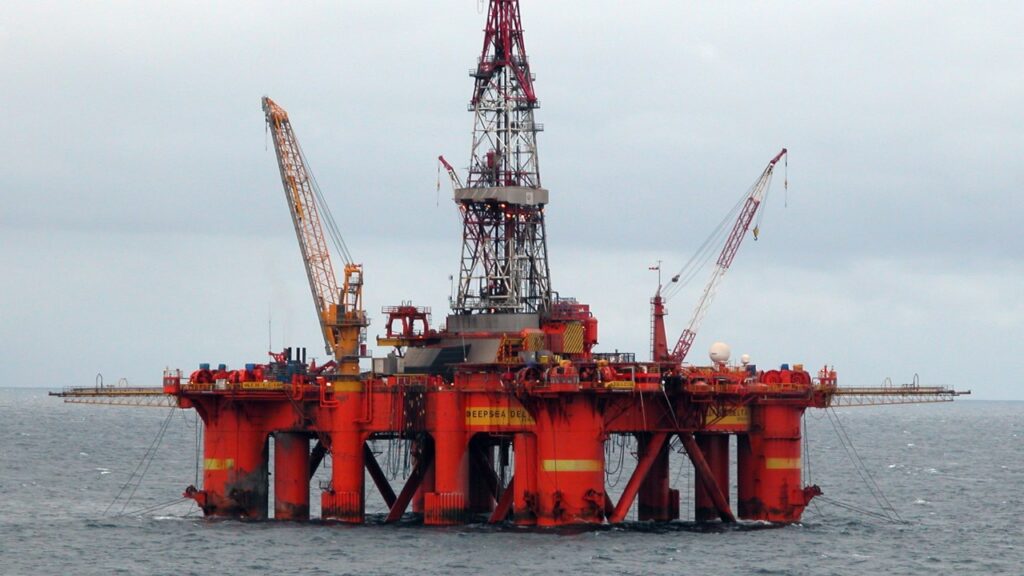
Deepsea Delta oil drilling rig operating in the North Sea

North Sea Oil at $110: The Case for New Drilling Still Doesn’t Add Up

Every time oil prices spike, calls to reopen North Sea exploration resurface. One point should be clear from the outset: domestic drilling will not lower the price at the pump. Oil is a globally priced commodity, and UK output is too small to move international markets. Proponents nonetheless put forward several arguments — that new exploration generates tax revenue, that the industry sustains tens of thousands of jobs across Scotland and beyond, and that domestically produced oil carries lower upstream and transport emissions than crude shipped from the Middle East. These arguments deserve to be taken seriously. But they do not answer the specific question this article examines: is new North Sea exploration financially viable under a genuinely no-subsidy regime, where operators must deposit the full decommissioning cost upfront before a single well is drilled?

The decommissioning deposit is not a procedural footnote. It is the mechanism that determines who ultimately bears the risk. Plugging and abandoning a well costs roughly $2.5–5 million; once associated infrastructure is included, the average rises to around $10 million per well. The total decommissioning liability across the UK Continental Shelf (UKCS) is estimated at $56 billion. Nuclear power stations are required to provision for decommissioning costs during their operating lives — the North Sea should be held to the same standard. When operators are permitted to defer payment, the public absorbs a contingent liability. That is a subsidy in economic effect, even if it carries no line item in a government budget. Exempting operators from upfront deposits is not a neutral regulatory choice; it is a transfer of risk from shareholders to taxpayers.

Existing fields already in production cost around $25 per barrel to operate in 2024, with some harder-to-reach fields exceeding $38. These figures reflect only the running costs of infrastructure that was built and paid for years ago. New exploration is a fundamentally different calculation. Operators must first fund seismic surveys and exploration wells, some of which will find nothing. If a viable discovery is made, developing it requires tens to hundreds of millions of dollars in new infrastructure. Adding operating costs over the field life and a full decommissioning deposit, and spreading everything across the recoverable barrels of what are now predominantly smaller, deeper, and geologically complex remaining reservoirs, the full-cycle cost of new North Sea production falls in the range of $90–115 per barrel.

The industry frequently cites the 78% windfall tax rate as proof that the fiscal regime deters investment. This argument obscures more than it reveals. The current system includes a 91% investment allowance that dramatically compresses the taxable base, meaning the effective burden on new capital is far lower than the headline rate implies. If the special fiscal regime were abolished entirely and oil extraction were taxed as an ordinary business at the standard corporation tax rate of 19–25%, with no special allowances and full decommissioning deposits required, the break-even price for new exploration would rise to around $120–130 per barrel. Cutting the headline tax rate sounds like relief for investors, but removing the investment allowance costs them far more. The result is counterintuitive but arithmetically straightforward: stripping away the current regime raises the break-even, because the allowance was doing more work than the rate reduction saves.

Brent crude broke $110 per barrel in March 2026, which at first glance appears to bring some projects within range. The futures market tells a different story. The US Energy Information Administration forecasts Brent will fall below $80 by the third quarter of 2026 and average around $64 in 2027. The current spike reflects the geopolitical shock of US military action against Iran and partial disruption to shipping through the Strait of Hormuz — not a structural shift in supply and demand. New North Sea projects take five to ten years from exploration to first production, and the industry plans on a long-run price assumption of $60–75 per barrel. Without a government-backed price floor, no bank will finance a decade-long project on the basis of a geopolitical premium that the futures curve has already priced out.

This exposes a fundamental contradiction. Every argument for reopening North Sea exploration, however it is framed, ultimately requires some form of government intervention — a price floor guarantee, investment allowances, or exemption from upfront decommissioning deposits. Each of these is a subsidy. Once public support is acknowledged as a precondition, the question shifts from whether to subsidise to where public money yields the most return. Equivalent resources directed at accelerating renewable energy deployment and improving energy efficiency would reduce structural demand for fossil fuels, delivering economic and environmental benefits that new North Sea fields cannot match.

The North Sea has moved from a growth basin to a harvest basin. The fiscally rational response to elevated oil prices is to adjust the tax regime to capture the windfall from existing production — not to subsidise a new round of exploration that cannot stand on its own commercial merits.

North Sea Oil at $110: The Case for New Drilling Still Doesn’t Add Up Read More »

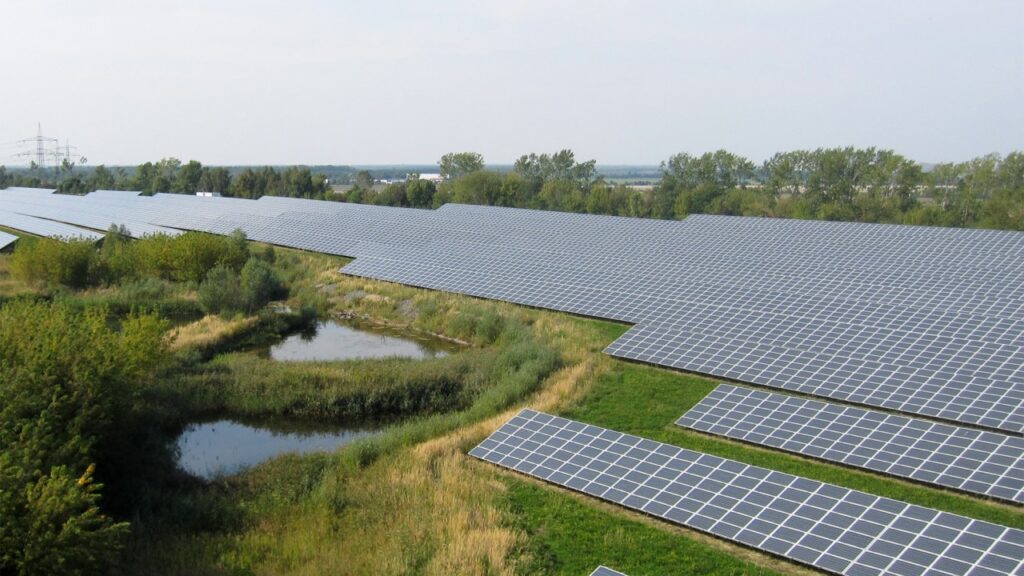
A large ground-mounted solar photovoltaic power plant in Saxony, Germany, with rows of solar panels stretching across an open landscape.

Why an Iran Crisis No Longer Sends European Power Bills Soaring

On 28 February 2026, US and Israeli forces launched strikes on Iran. Within hours, global energy markets were in turmoil.

The Strait of Hormuz carries roughly a fifth of the world’s daily oil supply and a large share of its liquefied natural gas. When the shooting started, commercial tanker traffic through the strait ground to a near standstill. Insurance premiums surged. Then, on 2 March, Iranian drones struck QatarEnergy’s production facilities at Ras Laffan, knocking out around 19% of near-term global LNG supply almost overnight. Europe’s benchmark gas contract, the Dutch TTF, jumped nearly 50% in a single session — the largest one-day move since Russia’s invasion of Ukraine in 2022 — briefly breaking through €63 per megawatt-hour, against €32 the week before. Brent crude approached $120 a barrel at its peak. For many Europeans watching the headlines, the feeling was familiar. Here we go again.

But something was different this time.

German and French wholesale electricity prices fell during the same week that gas markets were convulsing. That detail is worth sitting with.

Oil and gas surging while electricity holds steady — even dips — is not a coincidence. It reflects a structural change that has been quietly building for years. According to Ember, the energy research group, wind and solar together supplied 30% of EU electricity in 2025, surpassing fossil fuels for the first time on record. Five years earlier, that figure was 20%. In Germany, renewables already account for around 56% of net public electricity generation. Rabobank has estimated that without the cushion provided by renewable output, European power prices would currently be roughly a third higher than they are. For context, Dutch TTF gas futures peaked at €311 per megawatt-hour in August 2022, at the height of the last crisis. The current shock is real, but it is operating on a different scale.

The logic is not complicated. In a power market, prices are set by the marginal generator — the last plant needed to meet demand. When gas is expensive, gas-fired plants push prices up. But solar and wind have near-zero fuel costs. When sunshine and wind flood the grid with cheap electricity, they displace gas plants from the pricing queue and drag the market price down. This spring, that effect is unusually strong. BloombergNEF forecasts German solar output to rise around 25% year-on-year in April, with wind generation up approximately 70%. France’s nuclear fleet, which was badly degraded during the last crisis, is in far better shape. Analysts at the London Stock Exchange Group noted that Germany has been recording low or even negative prices during peak solar hours since mid-February — a phenomenon that normally does not appear until April.

Markus Krebber, chief executive of German energy group RWE, put it plainly: renewables offer stability precisely because they are not tied to imported fuels. The observation sounds simple. But it captures something that is often missing from the public debate about the energy transition — that solar panels and wind turbines are not just a climate policy. They are a form of geopolitical insurance. Every kilowatt-hour generated from domestic sunshine or wind is one fewer kilowatt-hour whose price can be held hostage by events in the Strait of Hormuz.

That insurance, however, is not complete.

Europe’s gas storage position is a serious vulnerability. According to Bruegel, the Brussels-based think tank, European gas inventories stood at around 46 billion cubic metres at the end of February 2026 — well below the 60 billion recorded a year earlier and the 77 billion in February 2024. Analysts expect storage to end March at only 22 to 27% of capacity, against a five-year average of around 41%. Europe will need to inject an enormous volume of gas over the summer refill season to reach safe levels before next winter, at exactly the moment when the LNG market is tightest.

There is also a more fundamental physical constraint. What happens when the sun goes down?

During daylight hours, solar generation suppresses prices — sometimes below zero. But as evening arrives and output fades, the grid falls back on gas-fired plants to fill the gap. The high price of gas then flows straight through into electricity costs. Earlier this month, evening power prices in the Netherlands briefly exceeded €400 per megawatt-hour. Germany saw similar spikes. The protection that renewables offer is unevenly distributed across the day: a buffer in the afternoon, a gap after dark. Battery storage is scaling up, but nowhere near fast enough to close that window. The evening peak remains the weak point in Europe’s new energy architecture.

What this crisis offers, then, is a rare real-world test. For years, the case for the energy transition rested largely on climate arguments — emissions targets, long-term responsibility, the costs of inaction. Those arguments remain valid. But the electricity market data from the past few weeks makes a different, more immediate case. A power system built on domestic wind and solar is structurally less exposed to the shocks that travel through fossil fuel markets. The more of your electricity that comes from sunlight and wind harvested at home, the less vulnerable your economy is to decisions made — or disruptions caused — on the other side of the world.

Krebber said after the crisis began that the signal to invest in electrification, and to break free from fossil fuel import dependency, is now stronger than it was before the war started. The direction is clear. But the gaps are real too — inadequate storage levels, exposed evening hours, industrial energy costs that remain stubbornly high across much of the continent. None of these are solved yet.

Every step forward in the energy transition is a reduction in exposure. Not a guarantee, not a complete solution — but a measurable, compounding reduction. For now, that is the most honest thing the data can tell us.

Why an Iran Crisis No Longer Sends European Power Bills Soaring Read More »

Paying People to Keep Burning Oil: The Cost of Inaction on Heat Pumps

In March 2026, the UK government announced over £50 million in emergency support for low-income households relying on heating oil. The funding comes from the Crisis and Resilience Fund, a pool of money designed to help vulnerable people through unexpected hardship. The trigger this time was a sharp rise in kerosene prices driven by Middle East tensions, with retail prices climbing from around 70 pence per litre in December 2025 to around 90 pence by March. Reports of suppliers cancelling existing orders and re-quoting at higher prices prompted the Chancellor to call in the Competition and Markets Authority. The immediate crisis was real. But so was the pattern behind it.

During the winter of 2022 to 2023, the UK government ran the Alternative Fuel Payment scheme, providing a one-off payment of £200 to households in off-grid homes to cushion the blow from post-Ukraine energy market chaos. The mechanism now is different; the logic is identical. Whenever geopolitics disrupts oil markets, roughly 1.6 million British households that heat their homes with kerosene absorb the shock directly, the government steps in with a payment, and then the underlying situation carries on unchanged. This cycle is not simply a story about an exposed group needing protection. It is a story about what happens when both government and households defer a necessary decision for long enough that crisis management becomes the default response.

The structural exposure of heating oil users is not a fixed feature of the landscape. Unlike gas and electricity customers, those who heat their homes with oil are not covered by the energy price cap, meaning they are exposed to more immediate energy price hikes. They purchase fuel directly from distributors, with no regulatory buffer and no fixed contract protection. But the reason so many households remain in this position is not purely infrastructural. The technology to move them off heating oil has existed and improved for years, the financial incentives to do so have been substantial, and yet the rate of transition has remained far too slow.

High-temperature heat pumps are a particular case in point. A high temperature heat pump is a type of air source heat pump that can deliver water temperatures of roughly 60 to 75 degrees Celsius, comparable to what a conventional oil boiler produces. In many cases, there is no need to replace existing radiators or upgrade insulation, as these systems tend to be easy to retrofit without changes to a building’s existing infrastructure. The retrofitting barrier that many households cite as a reason for hesitation is, in a significant number of cases, far smaller than assumed. One homeowner who replaced a 1990s oil boiler installation with a high-temperature heat pump reported that the cost of running at higher water temperatures was only 6 to 8 per cent more than a standard low-temperature heat pump range, while being able to reuse existing radiators and the hot water cylinder entirely.

The running cost argument has also shifted decisively for households currently on heating oil. Oil boiler yearly running costs for a typical household are approximately £1,104, over £500 more than comparable heat pump running costs. That calculation was made before oil prices climbed to their current levels. Pair a heat pump with a dedicated smart tariff that draws electricity during off-peak hours at lower rates, and the gap widens further. On a specialist heat pump tariff, running costs can drop to around £600 per year, cheaper than any gas boiler and considerably cheaper than today’s oil. The government currently offers a grant of £7,500 through the Boiler Upgrade Scheme, bringing the average installed cost of an air source heat pump to around £5,000 after the grant. The financial case for switching, particularly for households paying oil prices at their current level, is not marginal. It is clear.

The reluctance to act is therefore not primarily a matter of technology or affordability. It reflects a combination of inertia, unfamiliarity, and the reasonable human tendency to avoid disruption when the existing system is still functioning. These are understandable instincts. But when every period of elevated oil prices triggers a public subsidy, the cost of that reluctance is no longer borne by the household choosing to stay on oil. It is distributed across the public purse, which could otherwise be directing those resources toward accelerating the very transition that would make future bailouts unnecessary.

Government shares responsibility for this outcome. A coherent policy approach would use both incentives and graduated pressure: expanding grant access, improving installer availability in rural areas, and running sustained public information campaigns that explain what high-temperature heat pumps can actually do and what they cost to run. The media, too, tends to cover heating oil crises through the lens of household hardship and government response, without consistently reporting the accessible alternative sitting alongside the oil tank. That framing reinforces passivity rather than agency.

The decision to quietly drop the proposed 2035 ban on new fossil fuel boiler sales in early 2025, shifting to a purely carrot-based approach, removed one important signal of direction. A policy framework that relies solely on voluntary uptake, without any graduated cost on remaining with fossil fuels, will always struggle to overcome inertia at the pace the climate and the public finances require. Emergency oil payments are not inherently wrong. But every pound spent on them is a pound not spent on reducing the number of households who will need them again when the next price spike arrives. At some point, the repeated cycle of crisis and rescue has to give way to a more honest conversation about the cost of choosing not to change.

Paying People to Keep Burning Oil: The Cost of Inaction on Heat Pumps Read More »

Europe’s Energy Destiny: Why Fossil Fuel Self-Sufficiency Is Impossible

The core contradiction of Europe’s energy problem is simple: demand is large, but underground resources are limited. This is not a short-term policy failure or a temporary market fluctuation. It is closer to a geological destiny. Compared with regions such as the Persian Gulf or western Siberia, Europe simply does not possess the large petroleum basins capable of sustaining a modern economy for long.

Oil and gas are never distributed evenly across the planet. The world’s largest reserves are concentrated in only a few regions, notably the Persian Gulf and the West Siberian Basin. These areas were once covered by vast and stable shallow seas. Over millions of years, enormous quantities of microscopic marine life accumulated on the seabed, forming thick layers of organic-rich rock. As these layers were buried and heated, they transformed into hydrocarbons. Crucially, geological structures formed huge traps that allowed oil and gas to accumulate into giant fields.

Europe’s geological history followed a different path. Much of the continent sits on very old continental crust. Sedimentary basins tend to be smaller, and the region has experienced multiple episodes of tectonic deformation over geological time. These movements often fragmented potential reservoirs into smaller pockets. In other words, Europe is not devoid of hydrocarbons, but it rarely forms the giant fields that define major petroleum provinces.

The North Sea is the main exception. Formed during the opening of the Atlantic Ocean, this rift basin accumulated organic-rich sediments and developed good sandstone reservoirs. This allowed the United Kingdom and Norway to become major oil producers during the late twentieth century. Yet even the North Sea fields are much smaller than the giant fields of the Middle East, and most lie offshore, making extraction more expensive.

More importantly, the North Sea is now a mature basin. British production peaked in the early 2000s and has declined steadily since. Norway still maintains significant output, but new discoveries are generally smaller. Even if Norway is considered part of Europe’s broader energy system, total European oil production remains far below its consumption.

Natural gas offers a slightly stronger position, but the structural limits remain. The Groningen field in the Netherlands was once one of Europe’s largest gas sources, yet production has been phased out due to earthquake risks. Newer fields in the Norwegian Sea and the Barents Sea exist, but their scale cannot replace Europe’s import needs. Even after the reduction of Russian pipeline gas, Europe continues to rely heavily on imported liquefied natural gas.

This structural gap leads to a straightforward conclusion. Europe cannot achieve energy self-sufficiency simply by expanding fossil fuel extraction. Even if every potential basin were redeveloped, the most likely outcome would be a modest reduction in imports rather than a fundamental change in the balance.

That reality explains why Europe has invested heavily in wind and solar power in recent years, while retaining nuclear energy and exploring geothermal resources. Unlike oil and gas, these energy sources are far more evenly distributed. They allow countries to generate energy locally rather than relying on a handful of resource-rich regions.

Seen from this perspective, Europe’s energy transition is not only a climate policy but also a pragmatic response to geological constraints. When the limits of underground resources are already set by nature, the only variable left to change is the structure of the energy system itself. For Europe, reducing dependence on fossil fuels is the only way to escape this energy destiny.

Europe’s Energy Destiny: Why Fossil Fuel Self-Sufficiency Is Impossible Read More »

Scroll to Top