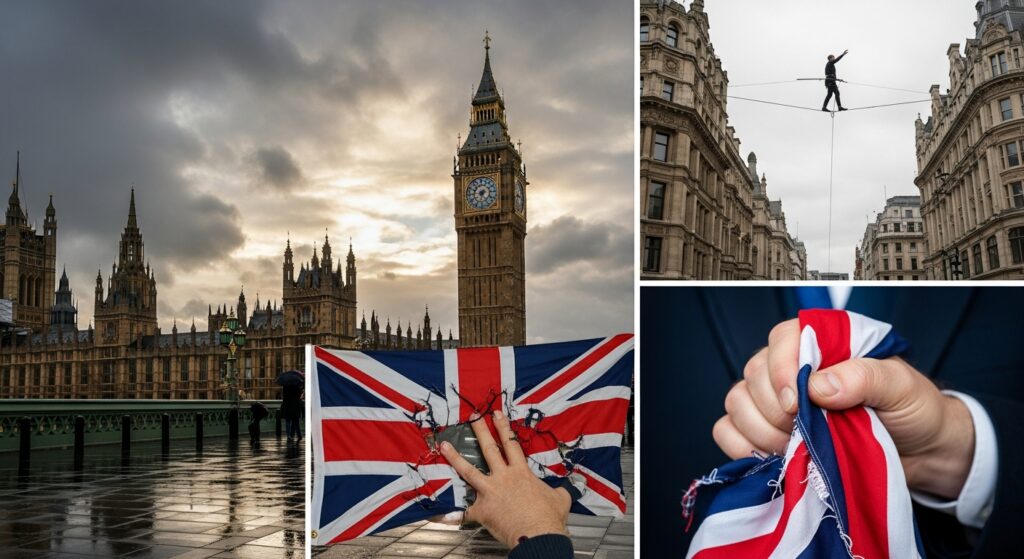
nThe UK’s Council Tax is a historical mistake born out of political chaos in the early 1990s. The system was introduced after Prime Minister Margaret Thatcher’s imposition of the Poll Tax, which sparked nationwide protests and riots. Her policy not only destroyed her own reputation but also led to the loss of a parliamentary seat for then Conservative Party Chairman Lord Chris Patten in the 1992 election. Patten, who later became the last Governor of Hong Kong, witnessed how a tax system could become a fatal burden for the ruling party. To quell public anger, John Major’s government hastily introduced the Council Tax in 1993 to replace the Poll Tax. While the new system stopped the political hemorrhaging, it was a rushed and compromised solution that sowed the seeds for future chaos.n
nThe biggest issue with the Council Tax is its outdated tax base. Property valuations in England are still based on 1991 figures and have not been updated for over thirty years. While property prices across the country have changed dramatically, taxes are still calculated using Cold War-era numbers. According to analysis by the Financial Times, more than half of all homes in the UK are incorrectly categorized in tax bands. As a result, multi-million-pound London apartments and ordinary homes in the North often pay similar tax amounts. This design not only violates the principle of fairness but also distorts the financial foundation of local governments.n
nRegional disparities further exacerbate this injustice. Residents in Burnley pay 4.5% of their income on Council Tax annually, while in Westminster, London, it’s only 0.1%. Poorer areas bear a heavier burden, while wealthier areas pay less. Worse still, poorer counties often require more social services spending—from elder care to public housing maintenance—while wealthier counties can supplement their finances with parking fees, fines, and commercial activities. The central government should balance these disparities through grants, but over the past decade, funding for local governments in the UK has been significantly cut, worsening this fiscal inequality. Consequently, poorer areas face the dual pressures of higher tax rates and reduced public services.n
nThe root of the problem lies in the misaligned system design. Council Tax uses property values as a long-term tax base but ignores the structural imbalances caused by asset accumulation and land scarcity. Low-income families, living in lower-value areas, end up paying relatively more, while the wealthy, owning high-value properties, enjoy implicit subsidies. Economists widely agree that the UK needs a wealth tax based on land or property net value to replace it. This would not only align tax burdens with wealth but also improve housing market efficiency and reduce regional distortions.n
nIn contrast, Hong Kong’s ‘Rates and Government Rent’ system, also originating from British colonial times, is fairer. Rates are reassessed annually based on property rental value, and government rent is adjusted according to land value. This means tax amounts are updated with market changes, making the tax burden more reflective of the actual economic situation. Even with Hong Kong’s volatile property prices, the tax system itself retains a self-correcting feature. By comparison, the UK’s Council Tax remains stuck in a static 1991 world, leaving taxpayers with a system disconnected from reality, lacking transparency and legitimacy.n
nThe Blair government once abandoned revaluation due to fear of public backlash, and now Chancellor Jeremy Hunt is similarly reluctant to address this ‘political minefield’. However, continued delay will only further undermine the system. Council Tax not only weakens local finances but also erodes public trust in fairness. If the UK is to truly rebuild the justice of its tax system, it must bravely move away from this 30-year-old temporary compromise and push for a new wealth-based local tax system. Only then can local governance return to a path of fairness and reality.n