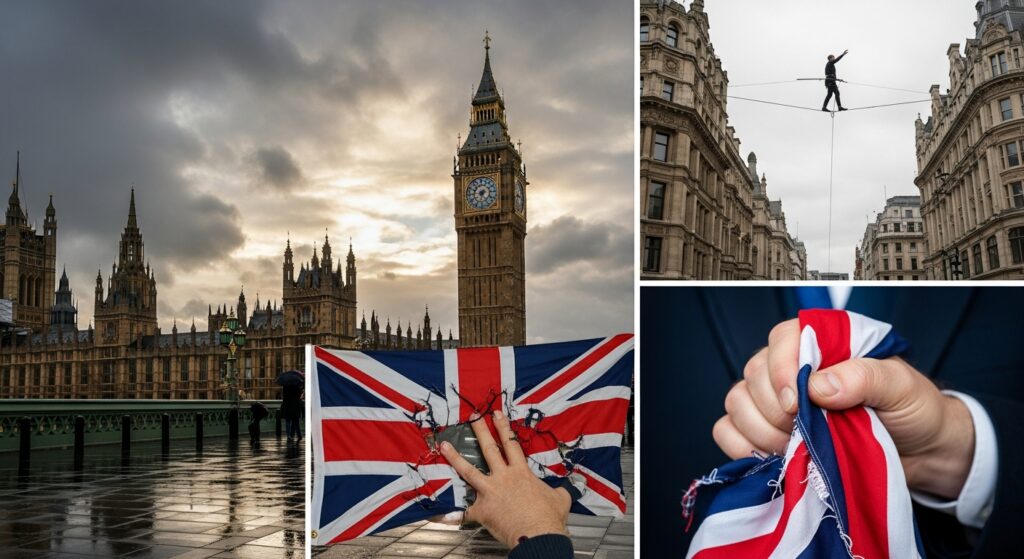
nA fierce debate has reignited in British politics in recent months. Conservative Party leader Kemi Badenoch announced at the party conference that if they return to power, they will lead the UK out of the European Convention on Human Rights (ECHR), replacing it with a ‘British Bill of Rights.’ Reform UK has long advocated the same stance, claiming that the European Court obstructs the UK’s ability to deport illegal immigrants. Both parties now echo each other, framing the exit from the ECHR as a symbol of ‘reclaiming sovereignty.’ While such rhetoric may resonate with some voters, it risks undermining the foundations of the British system, potentially plunging the United Kingdom into division and isolation.n
nThe ECHR is not a foreign imposition but was drafted under British leadership in the post-war era. Winston Churchill sought to prevent Europe from relapsing into tyranny and conflict, leading to the creation of the convention and the Council of Europe. Should the UK leave now, it would join Russia as the only European country to exit, with Belarus never having joined. Transforming from an advocate to a deserter symbolizes the UK’s abandonment of its post-war legacy and damages its international reputation as a guardian of the rule of law and human rights.n
nTo understand the consequences, one must begin with Northern Ireland. The Belfast Agreement brought Northern Ireland out of thirty years of conflict, establishing a framework for peace and autonomy. The agreement explicitly requires that Northern Irish law fully comply with the ECHR, allowing citizens to appeal injustices to the Strasbourg Court of Human Rights. This is not merely procedural design but a pillar of peace. If the UK exits, the principle of ‘no diminution of rights’ in Northern Ireland will be undermined, and the parity of esteem provisions under the Windsor Framework will become ineffective. The EU could then initiate dispute procedures, and the Irish government, along with nationalist factions, would demand a review of border and constitutional arrangements. Consequently, pressure for a referendum on Irish unification would rapidly increase.n
nFor the ‘United Kingdom of Great Britain and Northern Ireland,’ Northern Ireland is not just a territory but a symbol of ‘union.’ Losing it would destabilize the entire nation. Scottish independence voices have already resurfaced, and Welsh autonomy sentiment is strengthening. If Northern Ireland falls into turmoil, the federal structure will struggle to survive. Maintaining peace in Northern Ireland is not just diplomatic courtesy but a constitutional necessity.n
nThe economic repercussions of leaving the ECHR would also be significant. The UK-EU Trade and Cooperation Agreement stipulates that if either party is no longer bound by the convention, judicial and police cooperation can be immediately suspended. This would freeze Europol data sharing, cross-border extradition, and criminal intelligence. More importantly, once trust is lost, European businesses will reassess the legal stability of the UK, leading to increased trade barriers, supply chain delays, regulatory overlaps, and soaring compliance costs. Research from the London School of Economics indicates that non-tariff barriers post-Brexit have already significantly increased UK food prices. If judicial cooperation breaks down again, imported food inflation will worsen. When milk and bread on supermarket shelves become 10% more expensive, the sweetness of political slogans will turn into the bitterness of everyday life.n
nThe economy is just the beginning; more severe is the erosion of the rule of law and international reputation. The European Court of Human Rights has been the last resort for UK citizens facing government actions. Many controversial cases—detention rights, freedom of speech, family reunification—have required government compliance due to Strasbourg’s oversight. If the UK exits, it will become a defendant in its own court. Government power will lose external constraints, and judges will struggle to maintain independent scrutiny. In the long run, this will weaken public trust in the judicial system and cause foreign investors to doubt the legal protections of London’s financial center. When international businesses no longer trust that contracts will be fairly adjudicated, capital will quietly depart.n
nSome argue that leaving the ECHR would ‘regain border control,’ but this is merely a populist illusion. The crux of immigration issues lies in policy and enforcement, not the convention itself. Blaming all difficulties on the human rights court is merely a distraction. True sovereignty comes from trustworthiness and self-discipline, not arbitrary treaty-breaking. If the UK is unwilling to adhere to its own designed system, how can the outside world trust its treaty commitments?n
nThe rights protected by the ECHR—life, liberty, fair trial, speech, and belief—form the baseline of modern civilization. These principles are not imposed by Europe but are extensions of the British legal tradition. The convention provides everyone with tools to counterbalance public power, ensuring the state is under the law, not above it. Withdrawing from this system weakens not only individual protections but also society’s belief in fairness.n
nNorthern Ireland’s existence reminds us that the UK’s union is not natural but maintained by systems, trust, and consensus. The current withdrawal proposals by the Conservative Party and Reform UK effectively challenge these foundations. When peace structures are loosened, trade agreements are torn apart, and international trust is eroded, the United Kingdom will no longer have ‘union’ to speak of. This is not the rebirth of sovereignty but the beginning of a gradual national disintegration.n
nThe UK can reform and introspect, but not at the cost of destroying its institutions. Exiting the ECHR may earn short-lived applause but will lead to long-term decline. A truly strong nation is not an isolated one but one that seeks balance between freedom and responsibility. Today’s choices will determine whether tomorrow’s Britain is a robust United Kingdom or a fragmented island.n