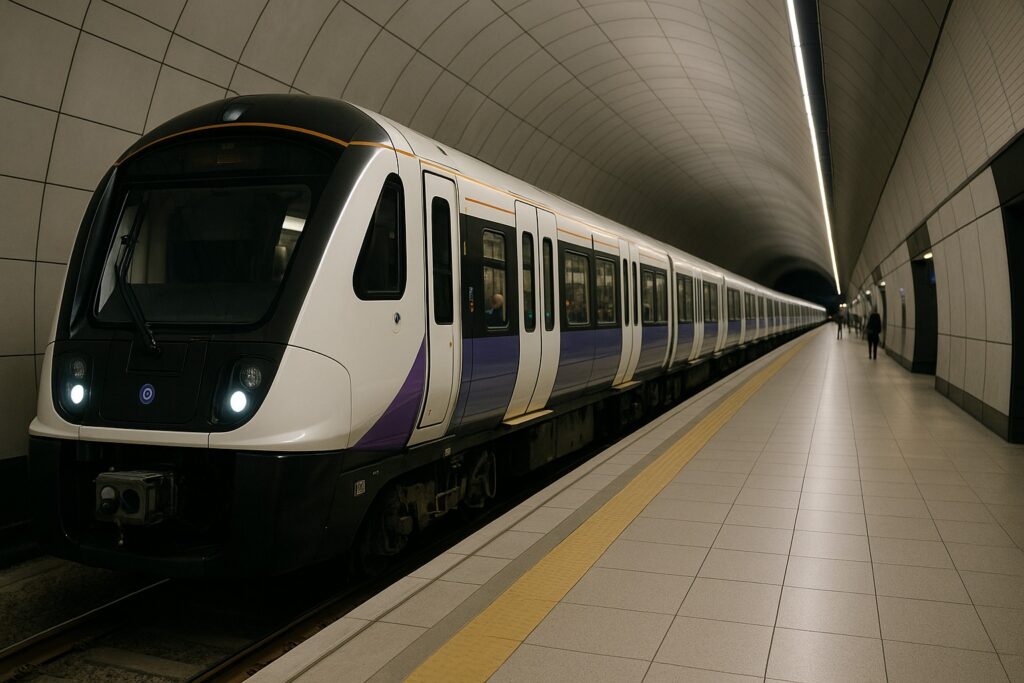
At 7.10 on the morning of 23 November 2026, a passenger train pulled out of Bristol Brabazon bound for Bristol Temple Meads. Catching a morning train to work is an ordinary enough thing to do in Bristol. Beside the old Filton Airfield, the last time anyone could do it was in 1964. For the next 62 years, people living nearby could see freight trains go by. Now they can board a train themselves, reach Temple Meads in around 20 minutes and change there for Bath, Cardiff or London.
The journey in the other direction gives a sense of which neighbourhoods the station now brings within reach. On opening day, the 9.04 from Temple Meads called at Lawrence Hill, Stapleton Road, Ashley Down and Filton Abbey Wood before reaching Brabazon at 9.25. Someone who lives near one of those stops and works in the Filton area can board along the way, with no need to travel into the centre first. The name on the railway map needs a little explanation. This is the Henbury line, but for now passenger trains terminate at Brabazon. Henbury is the next station planned.
That 21-minute journey has particular appeal for anyone who regularly drives into central Bristol. Even with a clear run, driving from Brabazon into the centre can take more than 20 minutes, before allowing for the time it takes to find a parking space. Congestion is common, and on a bad day several main roads can grind to a halt at once. For someone with a morning lecture or an appointment to keep, choosing a train that fits takes one of the least predictable parts of the journey out of the equation.
On the original plans, the station was called North Filton. The name on the platform signs is Brabazon, after the neighbourhood taking shape here. Where people once came to work at the airfield or the aircraft factory, residents are moving in and an old aircraft hangar now houses a bakery. In 2025, the government’s New Towns Taskforce reported that 6,500 homes already had planning permission on the Brabazon site alone. The train has arrived while the neighbourhood is still being built. Anyone viewing a home here can walk from the front door to the platform and try the commute for themselves. A dotted line in a sales brochure could never tell them quite as much.
Among the most remarkable buildings on the old airfield are the hangars where Concorde was built. Aircraft that could cross the Atlantic at supersonic speed took shape here. Soon it will be musicians and their audiences coming through the doors. The developer expects the 20,000-capacity Aviva Arena beside the new station to be completed in late 2028. Someone travelling to a concert from outside Bristol could then arrive at Temple Meads on a long-distance train and change for a local service to the venue. For an arena outside the city centre, that is a route home worth printing on the ticket.
Getting people to a concert is one thing. Getting them home is another. Some arrive early for dinner, others just in time for the opening number, but almost everyone gets up when the last song ends. If only one in ten people at a sell-out show chose the train, that would still mean 2,000 people heading for the same station. Brabazon already has an accessible footbridge linking its two platforms. A second phase of work, due to continue through to 2028, includes another footbridge with ramps, a staffed ticket hall with barriers, toilets and a station square. The square will give people room to wait while groups make their way onto the platforms. What time they get home will depend on how many trains run that evening.
It is a pity, then, that Great Western Railway is starting with just one train an hour. The 9.04 took 21 minutes to reach Brabazon. Anyone who reached the platform at 9.05 had to wait until 10.04 for the next departure. There is a prospect of a half-hourly service. According to the West of England Combined Authority, the rail industry expects the line to have room for a second train each hour once the works are complete, including a facility beyond Henbury where trains can reverse. The extra service still needs a business case and funding for additional trains. The authority intends to increase the frequency as the neighbourhood and arena develop, but has yet to set a date.
Local councillors are already asking whether the railway could go further. At a scrutiny meeting in October 2025, members pointed to the 6,500 homes approved at Brabazon and asked where the money for four trains an hour would come from. The transport director explained that the original second phase of MetroWest provided for an hourly service. By June 2026, committee papers set out plans to use transport development funding to investigate running up to four trains an hour between Temple Meads and Brabazon. The study will compare routes and examine where extra passenger services might fit alongside trains already using the tracks. Councillors should get a clearer answer about what it would take. A start date will have to wait.
Why four trains an hour? Space them evenly and there is a train every 15 minutes. Bristol Rail Campaign calls this a ‘turn up and go’ service. In 2025 it urged the regional mayor to prioritise a 15-minute frequency from Temple Meads towards Clifton Down and Henbury. Imagine arriving back at Temple Meads a few minutes late on a long-distance train, just as your connection pulls away. If another is due in a quarter of an hour, you can take your time walking to the platform. If it is nearly an hour away, you are probably already reaching for your phone to find another way home.
The trains themselves could change too. The photograph taken on the platform on opening morning shows a dark green Great Western Railway train with a yellow cab front. The number is clearly visible: 166221, a Class 166 diesel unit. The combined authority has put around £1 million into work on the infrastructure that battery trains would need. One of the routes it is looking at first is the future service from Portishead through Brabazon to Henbury. A battery train can use stored electricity on stretches without overhead wires. Where it can recharge, and how long it can stand before the return trip, both matter when drawing up a timetable. The money is for development work. There is no date yet for a change of trains.
At the other end of the journey, one improvement is ready to use the moment you step off the train. Above the glass doors at the new eastern exit from Temple Meads, yellow arrows point towards St Philip’s Marsh and the University of Bristol’s Temple Quarter campus. The entrance opened on 7 September 2026. Engineers extended the existing passenger subway beneath platforms 13 and 15 as part of the £23 million project. A student arriving from Brabazon can now follow the arrows, walk through the barriers and come straight out at the campus. For someone travelling in and out five days a week, that is a detour saved ten times over.
At one end there is a new station beside an old airfield. At the other, a new door from a familiar station into a university campus. Together they make journeys possible in both directions. Someone living at Brabazon can take the train to a lecture in town. Friends in the city can head the other way for coffee in an old hangar and, in time, a concert nearby. One train an hour still means checking the timetable before leaving home. After 62 years, though, people along this stretch of line have a train to catch again. Would a half-hourly service persuade you to leave the car at home, or would it take a train every 15 minutes before you felt happy just turning up?