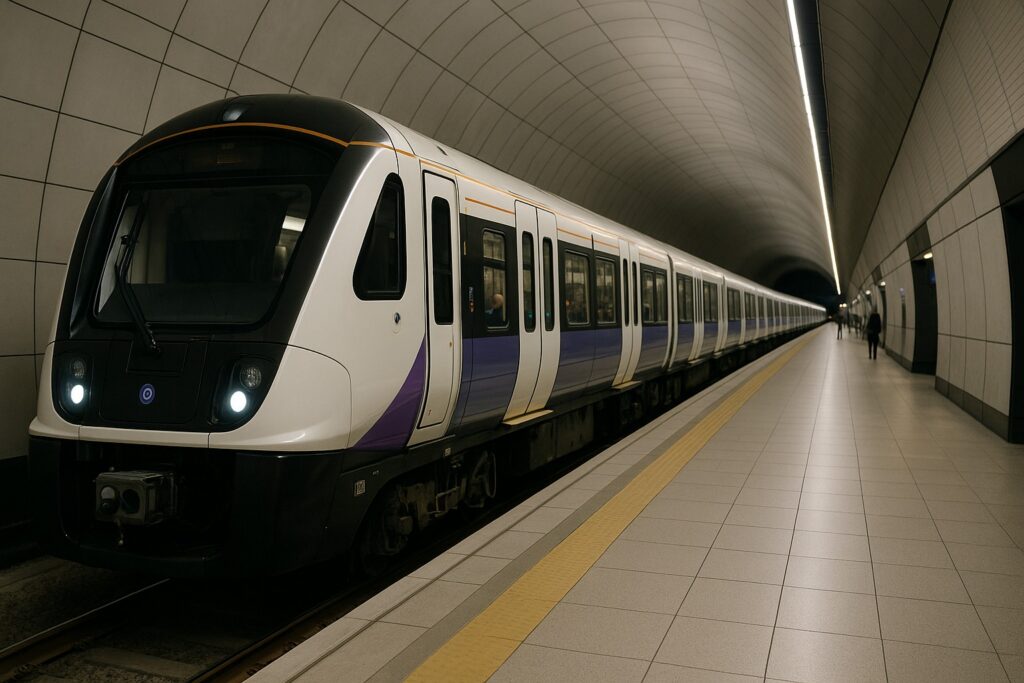
Every few years, someone declares that high-speed rail is on the verge of becoming obsolete. The arguments are often compelling: autonomous driving will make roads smarter, flying cars could alleviate traffic from above, and Hyperloop might propel people through vacuum tubes at incredible speeds. The question, however, is not whether these technologies can be developed, but whether they can operate sustainably, reliably, and affordably on a civilizational scale.
Let us first consider autonomous driving. Removing the driver does not widen the roads. The true limitation of transportation systems has never been response speed, but rather throughput. A dual-track high-speed rail can transport 10,000 people per hour in one direction during peak times, a standard performance for a mature system. To accommodate the same flow of people on highways, assuming autonomous driving is highly developed and each vehicle averages 1.5 passengers, a single lane of a highway would only support about 3,000 people per hour, all while ignoring the space taken by heavy vehicles, merging from side roads, deceleration at exits, speed differentials, and accident risks.
In other words, to match the capacity of high-speed rail, one would need to construct ten or more additional lanes, not just a few extra tracks. This is not merely a technical issue but also a matter of cost and environmental impact. The extensive land acquisition, bridges and elevated structures, sound barriers and drainage systems, along with long-term maintenance and management, all represent significant expenses and ecological damage. In contrast, high-speed rail requires only a controlled corridor, which occupies far less land and causes less environmental fragmentation than an equivalent highway network. If roads were to replace high-speed rail, the costs would not increase linearly but would spiral out of control.
The concept of flying cars requires a reality check. They are not competitors to high-speed rail but could only serve as ‘air taxis.’ This is evident when examining energy consumption. High-speed rail, relying on steel wheels on steel tracks with centralized traction, has an extremely low energy consumption of about 0.05 kWh per passenger per kilometer. In contrast, flying taxis must continuously counteract gravity, and vertical takeoff and landing are inherently energy-intensive activities. Based on existing eVTOL prototypes and public estimates, even at ideal passenger loads, their energy consumption is approximately 1.5 to 2 kWh per passenger per kilometer, which is 30 to 40 times that of high-speed rail. Such energy levels dictate that they can only be used for urgent needs or high-value transport, and cannot serve as the backbone of mass transit. Treating flying taxis as mainstream is merely institutionalizing energy waste.
As for Hyperloop, which seems the most advanced, it is actually the least viable. The issues lie not only in the high costs of vacuum tubes but also in the structural disadvantages regarding capacity and energy consumption. A high-speed train can carry between 800 and 1,200 passengers with trains running every few minutes, resulting in naturally high throughput. Most Hyperloop designs utilize small capsules that carry about 20 to 30 people. Even if they could run every two minutes, they would only transport 600 to 900 passengers per hour in one direction. To replace a high-speed rail line, one would need to construct over ten parallel tubes.
Moreover, each tube must maintain near-vacuum conditions over the long term. Considering a tube several hundred kilometers long and a few meters in diameter, the volume would be in the millions of cubic meters, meaning any minor leak necessitates continuous pumping to compensate. The more tubes there are, the more seams there are, making thermal expansion and contraction, ground subsidence, and material fatigue increasingly difficult to manage. Energy and maintenance costs will only accumulate, not offset. The result is that to allow a few people to travel faster, one would incur higher construction and operational costs than high-speed rail, yet still fail to match its capacity and reliability.
When these three ‘alternative solutions’ are assessed together, the conclusion is quite clear. High-speed rail will not become obsolete not because it is conservative, but because it has achieved an irreplaceable balance among cost, energy, capacity, and safety that remains unmatched. Autonomous driving is suitable for urban and last-mile transport, flying taxis are only appropriate for emergencies and high-value scenarios, and Hyperloop remains at a stage where engineering calculations do not add up. A truly mature transportation system does not replace infrastructure with fantasies but allows each technology to play its role. What will become outdated is not high-speed rail, but those future visions that refuse to confront scale and reality.