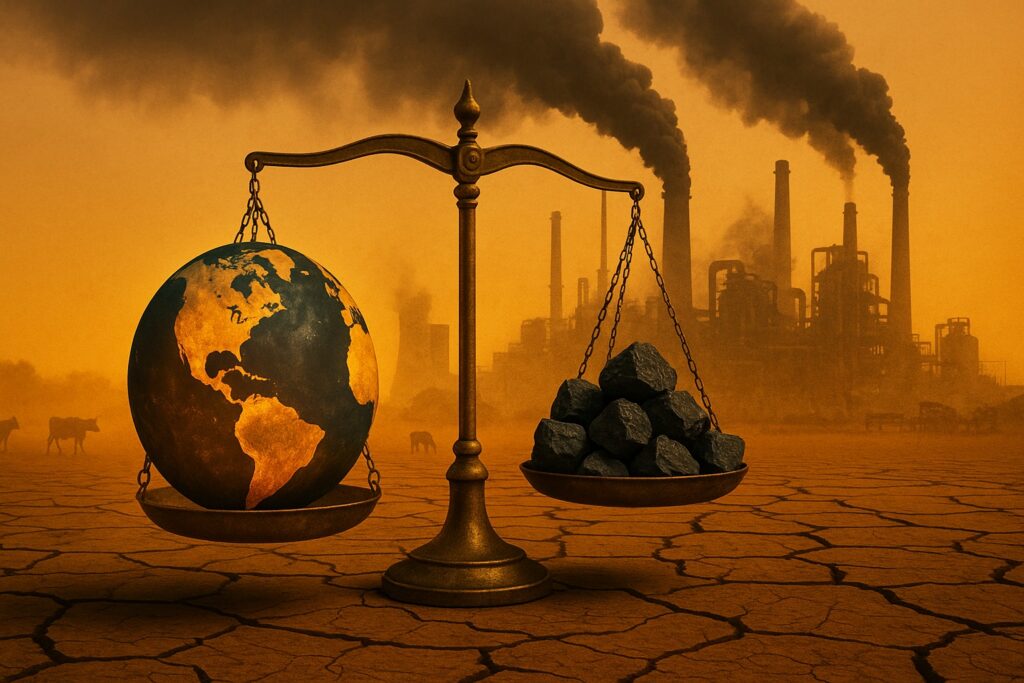
A decade ago, mainstream discussions on climate change were notably pessimistic. Many models projected global warming to reach 3–4°C, which was considered a reasonable forecast, assuming the world would continue to rely on a high-carbon energy system, with transitions being slow and costly. By 2025, this assumption has clearly begun to waver.
When only accounting for implemented policies, the median estimate for global warming now stands at approximately 2.8°C. While this is certainly not an ideal outcome, it represents a significant downward shift in the risk range compared to ten years ago. This change is not merely rhetorical; it reflects a fundamental rewriting of the trajectory of the energy system itself.
The most evident turning point has occurred in the electricity sector. In 2025, global renewable energy generation is likely to surpass coal power for the first time in total output. While coal power has not disappeared, it no longer dominates new supply, serving primarily as backup during peak demand or emergencies. The rapid expansion of solar and wind energy has reached a pace capable of reshaping the entire system’s focus.
This is not just a story of wealthy nations. An increasing number of developing countries are directly entering the renewable energy era, bypassing the traditional transition path from coal to gas and then to renewables. For these countries, this is not a moral choice but a rational investment. Solar and wind energy can be deployed in a decentralized manner and brought online quickly, without the need for prior investments in heavy assets like refineries, oil storage, or gas pipelines, thus avoiding the burden of stranded assets in a net-zero world. In these regions, energy transition is no longer an expensive environmental policy but rather the cheapest and most flexible development solution.
Turning to the world’s largest emitter, China’s carbon emissions have likely peaked. Recent trends indicate that total emissions are no longer rising in tandem with economic growth, with new energy sources primarily coming from non-fossil origins, and coal’s role shifting to supply security and backup. This suggests that the steepest segment of the global emissions curve is being flattened. This alone has a substantial impact on global climate risk.
Cost is the most significant driver of this transformation. A decade ago, solar and wind energy were heavily reliant on subsidies; by 2025, they have become the cheapest new sources of electricity in most regions. The rapid expansion of battery storage has further enhanced the resilience of the electricity system, rendering the argument of ‘instability’ increasingly untenable.
Changes in the transportation and building sectors have similarly reinforced this trend. Global annual sales of electric vehicles have surpassed 14 million, and in many markets, total ownership costs are now lower than those of fuel-powered vehicles. In Europe and parts of Asia, the annual installation of heat pumps has also increased several times compared to a decade ago. While overall renewal will take time—not due to a lack of direction, but because of the large existing number of vehicles and buildings—the technological choices for new and retrofitted installations have already shifted and are accelerating.
For this reason, the 4°C world that was seriously discussed a decade ago is no longer at the core of mainstream analysis. This is not because the problem has vanished, but because certain high-risk pathways have gradually been closed off by market, technological, and engineering realities.
Of course, challenges remain. Grid construction, storage scale, approval speed, and geopolitical factors could all slow progress. However, unlike in the past, the direction is now clear, and the tools are in place.
What is worthy of reflection and affirmation in 2025 is not that the world is now safe, but that it has demonstrated that energy transition can be faster, cheaper, and more pragmatic. From developed economies to developing countries, low-carbon energy is gradually becoming the default option rather than the exception.