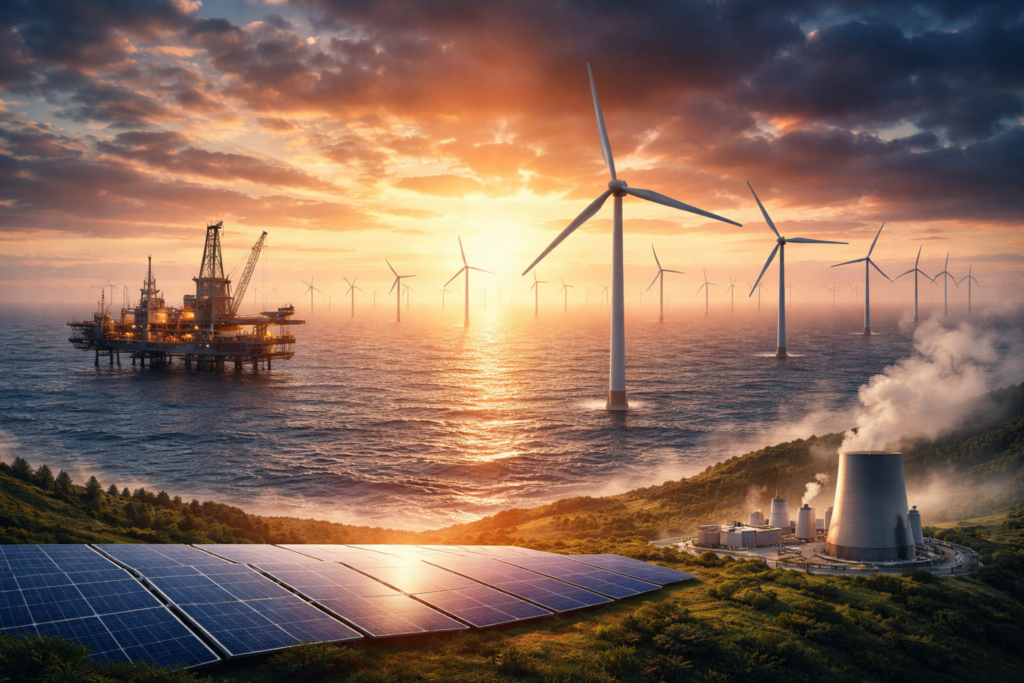
In 2008, Uruguay did not have a single wind turbine, nor a single solar panel. It powered a fast-growing economy — expanding by 5 to 7 per cent a year — on imported oil and a handful of ageing hydroelectric dams. When droughts struck, hydro output halved; when oil prices spiked, the entire country paid the bill. A decade and a half later, this South American nation of 3.5 million people now draws 98 per cent of its electricity from renewable sources. Generation costs have been roughly halved, and around 50,000 jobs have come with the transition. Over the same period, Britain reached its first full year without coal power in 2025, with renewables now supplying more than half of electricity generation. Hong Kong, by contrast, is still in the early stages of replacing coal with natural gas, and is not aiming for net-zero electricity until 2050. The gap between these three trajectories points to one uncomfortable conclusion. Uruguay’s achievement is often described as a green miracle. It was not a miracle. It was an institutional design.
The architect of the transition was a physicist, Ramón Méndez Galain, who served as Uruguay’s National Director of Energy from 2008 to 2015. His diagnosis cut against the conventional grain. A fossil-fuel system runs on a simple logic — buy fuel, sell electricity. Renewable energy has almost no fuel costs; nearly all the spending is upfront capital. The decisive question is therefore not the generation technology itself, but how to reduce the risk that this capital faces. A short-term spot market cannot do that; only a long-term capacity market can. Uruguay accordingly legislated to authorise its state utility, UTE, to run open auctions in which winning developers were guaranteed 20-year fixed-price power purchase contracts. Once prices stabilised, capital arrived. Within a decade, more than 700 wind turbines had been installed and roughly six billion US dollars had been invested.
The cleverest design choice was to substitute combination for storage. Uruguay runs hydropower, wind, biomass and solar in parallel — in 2024, hydro still supplied around 40 per cent and wind close to 30 per cent, with the proportions shifting year to year as rainfall varies. When droughts cut hydro, wind picks up the slack; when winds slacken, the reservoirs cover. The hydro reservoirs themselves act as enormous natural batteries, while interconnectors with Argentina and Brazil provide a flexible regional buffer for surplus and shortfall alike. The system therefore did not need expensive electrochemical storage. When low rainfall and weak winds coincide — as during the severe La Niña drought of 2022 to 2023 — a small amount of natural gas generation and cross-border imports steps in. That residual one to two per cent of fossil fuel is the safety valve at the heart of the design. Notably, Uruguay only began connecting its first large-scale battery storage systems to the grid in 2026, primarily to support the next phase of green hydrogen exports and full zero-carbon supply. The 98 per cent achievement of the past decade was reached without a single grid-scale battery.
What truly held the system together was political architecture, not engineering. Méndez bound every political party, trade union, business association and civil society group into a single energy policy. Parliament passed cross-party resolutions that wrote the long-term targets into national policy. Several governments have come and gone since — across the political spectrum — without disturbing the basic trajectory. The reason is not shared ideology. It is that every actor was tied into the same set of contracts: UTE’s auction commitments, 20-year power purchase agreements, cross-border grid arrangements. Unwinding any of them would mean dismantling the country’s commercial credibility along with them. No incoming government has been willing to pay that price.
The Uruguayan model is not without cost or constraint. Its existing large hydroelectric plants are mid-twentieth-century inheritances; building dams of comparable scale today would not survive contemporary environmental and indigenous-rights review. Its biomass capacity depends on by-products from local sugar and timber industries that other countries cannot easily replicate. What is genuinely exportable is therefore not the technical recipe, but three institutional principles: write long-term contracts into law, embed cross-sector consensus into policy, and design the system to minimise risk for private capital.
Britain’s problem is almost the inverse. The technology is plentiful — its wind resources are world-class, and on one half-hour in April 2025 the grid even ran 97.7 per cent zero-carbon. Long-term contract mechanisms exist as well, in the form of Contracts for Difference, which guarantee renewable generators a fixed strike price for fifteen years. But the wholesale market still sets its marginal electricity price by gas, so even when renewables exceed half of generation, household bills continue to track international fuel markets. Nuclear plants are ageing without replacement, storage and grid infrastructure lags behind generation growth, and successive governments have tightened and loosened commitments to the 2030 clean power target. What Uruguay completed in a decade, Britain has been working on for over twenty years and has yet to finish. The shortfall is not in the turbines. It is in the continuity of policy and the structure of the market.
Hong Kong’s predicament is different again. With limited land, dense population, no large-scale hydropower and modest wind and solar potential, the government’s own estimate is that local renewable generation can reach only 3 to 4 per cent by 2030. The remainder of the path must come from gas displacing coal, expanded nuclear imports from Daya Bay and other mainland plants, and possibly hydrogen and regional grid integration after 2035. This is essentially a substitution problem between fossil fuels and nuclear power, not a renewable expansion problem. But the institutional lessons from Uruguay still apply. The core question is not technical feasibility — it is whether a credible, legally binding long-term commitment exists. If Hong Kong could reach a cross-border renewable supply agreement with the mainland that sets out the decarbonisation timetable and capacity quotas for 2035 and 2050 in clear terms, the investment plans of the two local power companies, the cross-border transmission infrastructure and the trajectory of consumer tariffs could finally move out of year-by-year ambiguity and onto a predictable decarbonisation pathway.
Energy transition is most often misread as an engineering battle. Uruguay’s story shows it is closer to a contracts battle — over how governments commit, how markets allocate risk, and how political factions agree. A nation of 3.5 million has done what a wealthy Britain has dragged out for two decades and what a constrained Hong Kong has been forced to navigate around. The difference is not money, and it is not technology. It is whether anyone is willing to rewrite the rules thoroughly enough that even the next government cannot unwind them.